


Page 64 - IJAMD-2-1
P. 64
International Journal of AI for
            Materials and Design
                                                                             Fatigue life prediction via contrastive learning


            similar and dissimilar samples to extract features, without   In this work, contrastive learning was applied to
            relying  on  manually  labeled  data   In the contrastive   the multiaxial fatigue life prediction of materials, using
                                         58
                                        .
            learning framework, a pair of samples (positive and   stress-strain hysteresis data as the input. Considering
            negative pairs) is typically constructed, where positive   that contrastive learning can reduce the distance between
            pairs consist of similar or related samples and negative   similar samples in the feature space, this framework
            pairs consist of dissimilar samples. The model’s objective   aims to extract general, discriminative features that are
            is to minimize the distance between positive pairs and   shared by samples with the same amplitude but different
            maximize the distance between negative pairs. This learning   loading paths. These features were then used to construct
            approach effectively utilizes unlabeled data and enhances   a downstream fatigue life prediction model. The core idea
            the model’s generalization ability on real-world data.   of contrastive learning was implemented by constructing
            Contrastive learning has been widely applied to various   positive and negative sample pairs. The construction of
            tasks,  such as  image  recognition, 59,60   natural  language   these pairs was done by the data augmentation module,
            processing, 61,62  and audio analysis, 63,64  demonstrating   which randomly selected a small batch of data containing
            outstanding performance. Especially in the field of image   N samples. Negative samples were not specifically sampled,
            processing, contrastive learning learns powerful visual   and after data augmentation, 2N data samples were
            feature representations by leveraging samples generated   generated. In this case, for each positive sample pair, there
            from different perspectives, sizes, or other transformations   were 2(N−1) corresponding negative pairs. In this study,
            of images.                                         data  augmentation involved adding  Gaussian  noise  and
              Among all contrastive learning models, SimCLR    applying time masking. Each sample was augmented with
                                                         65
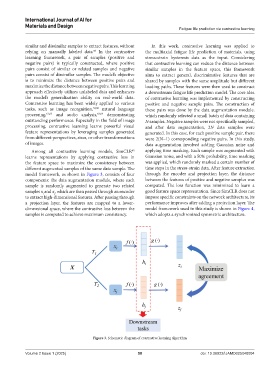
            learns representations by applying contrastive loss in   Gaussian noise, and with a 50% probability, time masking
            the feature space to maximize the consistency between   was applied, which randomly masked a certain number of
            different augmented samples of the same data sample. The   time steps in the stress-strain data. After feature extraction
            model framework, as shown in Figure 3, consists of four   through the encoder and projection layer, the distance
            components: the data augmentation module, where each   between the features of positive and negative samples was
            sample is randomly augmented to generate two related   computed. The loss function was minimized to learn a
            samples x and x, which are then passed through an encoder   good feature space representation. Since SimCLR does not
                   i
                        j
            to extract high-dimensional features. After passing through   impose specific constraints on the network architecture, its
            a  projection  layer,  the  features  are  mapped  to  a  lower-  performance improves after adding a projection layer. The
            dimensional space, where the contrastive loss between the   model framework used in this study is shown in Figure 4,
            samples is computed to achieve maximum consistency.  which adopts a synchronized symmetric architecture.


                                         Figure 3. Schematic diagram of contrastive learning algorithm


            Volume 2 Issue 1 (2025)                         58                        doi: 10.36922/IJAMD025040004

