


Page 69 - IJAMD-2-1
P. 69
International Journal of AI for
            Materials and Design
                                                                             Fatigue life prediction via contrastive learning


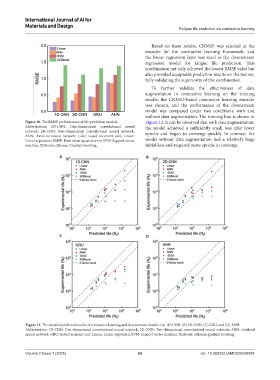
                                                                 Based  on  these  results,  CNN1D  was selected  as  the
                                                               encoder for the contrastive learning framework, and
                                                               the  linear  regression layer  was  used  as  the downstream
                                                               regression model for fatigue life prediction. This
                                                               combination not only achieved the lowest RMSE value but
                                                               also provided acceptable prediction results on the test set,
                                                               fully validating the superiority of this combination.

                                                                 To further validate the effectiveness of data
                                                               augmentation in contrastive learning on the training
                                                               results,  the  CNN1D-based  contrastive  learning  encoder
                                                               was chosen, and the performance of the downstream
                                                               model  was  compared  under  two  conditions:  with  and
                                                               without data augmentation. The training loss is shown in
            Figure 10. The RMSE performances of life prediction models.  Figure 12. It can be observed that with data augmentation,
            Abbreviations: 1D-CNN:  One-dimensional  convolutional neural   the model achieved a sufficiently small loss after fewer
            network; 2D-CNN: Two-dimensional convolutional neural network;   epochs and began to converge quickly. In contrast, the
            ANN: Artificial neural network; GRU: Gated recurrent unit; Linear:
            Linear regression; RMSE: Root mean squared error; SVM: Support vector   model without data augmentation had a relatively large
            machine; XGBoost: eXtreme Gradient boosting.       initial loss and required more epochs to converge.

                          A                                    B


                          C                                    D


            Figure 11. The detailed predicted results of contrastive learning and downstream models: (A) 1D-CNN, (B) 2D-CNN, (C) GRU, and (D) ANN.
            Abbreviations: 1D-CNN: One-dimensional convolutional neural network; 2D-CNN: Two-dimensional convolutional neural network; ANN: Artificial
            neural network; GRU: Gated recurrent unit; Linear: Linear regression; SVM: Support vector machine; XGBoost: eXtreme gradient boosting.


            Volume 2 Issue 1 (2025)                         63                        doi: 10.36922/IJAMD025040004

