


Page 70 - IJAMD-2-1
P. 70
International Journal of AI for
            Materials and Design
                                                                             Fatigue life prediction via contrastive learning


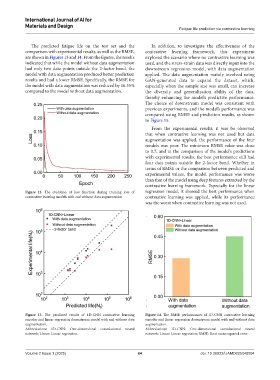
              The predicted fatigue life on the test set and the   In addition, to investigate the effectiveness of the
            comparison with experimental results, as well as the RMSE,   contrastive learning framework, this experiment
            are shown in Figures 13 and 14. From the figures, the results   explored the scenario where no contrastive learning was
            indicated that while the model without data augmentation   used, and the stress-strain data was directly input into the
            had  only  two  data  points  outside  the  2-factor  band,  the   downstream regression model, with data augmentation
            model with data augmentation produced better prediction   applied. The data augmentation mainly involved using
            results and had a lower RMSE. Specifically, the RMSE for   GAN-generated data to expand the dataset, which,
            the model with data augmentation was reduced by 16.35%   especially when the sample size was small, can increase
            compared to the model without data augmentation.   the  diversity  and  generalization  ability  of  the  data,
                                                               thereby enhancing the model’s predictive performance.
                                                               The choice of downstream model was consistent with
                                                               previous experiments, and the model’s performance was
                                                               compared using RMSE and prediction results, as shown
                                                               in Figure 15.
                                                                 From the experimental results, it was be observed
                                                               that when contrastive learning was not used but data
                                                               augmentation  was  applied,  the  performance  of  the  four
                                                               models was poor. The minimum RMSE value was close
                                                               to 0.7, and in the comparison of the model’s predictions
                                                               with experimental results, the best performance still had
                                                               four data points outside the 2-factor band. Whether in
                                                               terms of RMSE or the comparison between predicted and
                                                               experimental  values,  the model performance was worse
                                                               than that of the model using deep features extracted by the
                                                               contrastive learning framework. Especially for the linear
            Figure  12. The evolution of loss function during training loss of   regression model, it showed the best performance when
            contrastive learning models with and without data augmentation  contrastive learning was applied, while its performance
                                                               was the worst when contrastive learning was not used.


            Figure  13. The predicted results of 1D-CNN contrastive learning   Figure  14.  The RMSE performances of 1D-CNN  contrastive learning
            encoder and linear regression downstream model with and without data   encoder and linear regression downstream model with and without data
            augmentation.                                      augmentation.
            Abbreviations: 1D-CNN:  One-dimensional  convolutional neural   Abbreviations: 1D-CNN:  One-dimensional  convolutional neural
            network; Linear: Linear regression.                network; Linear: Linear regression; RMSE: Root mean squared error.


            Volume 2 Issue 1 (2025)                         64                        doi: 10.36922/IJAMD025040004

