


Page 66 - IJAMD-2-1
P. 66
International Journal of AI for
            Materials and Design
                                                                             Fatigue life prediction via contrastive learning


            their ability to represent features effectively. Finally, based   cycle. Therefore, to further determine which encoder
            on the learned feature representations, a performance   structure was more suitable for the original data, four
            comparison is conducted for downstream life prediction   structures—One-Dimensional  Convolutional  Neural
            tasks, examining the predictive effectiveness across various   Network (1D-CNN), Two-Dimensional Convolutional
            machine learning models.                           Neural Network (2D-CNN), Gated Recurrent Unit (GRU),
                                                               and ANN—were used. The high-dimensional features
            4.1. Performance with different encoder network    extracted by the encoder were passed through two fully
            architectures                                      connected layers and uniformly reduced to 64 dimensions,
            In this section, the experiment first determined two   and training was conducted on the stress-strain hysteresis
            hyperparameters of the proposed contrastive learning   data.  Table 2 provides the detailed hyperparameters of
            framework: the number of layers in the encoder and   the contrastive learning models with different network
            the output feature dimension. The framework of the   frameworks.
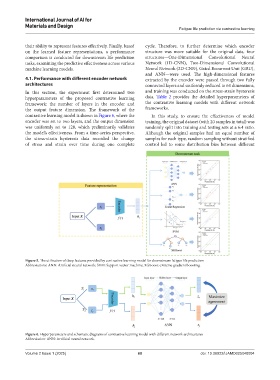
            contrastive learning model is shown in Figure 6, where the   In this study, to ensure the effectiveness of model
            encoder was set to two layers, and the output dimension   training, the original dataset (with 20 samples in total) was
            was uniformly set to 128, which preliminarily validates   randomly split into training and testing sets at a 6:4 ratio.
            the model’s effectiveness. From a time-series perspective,   Although the original samples had an equal number of
            the stress-strain hysteresis data recorded the change   samples for each type, random sampling without stratified
            of stress and strain over time during one complete   control  led  to  some  distribution  bias  between  different


            Figure 5. The utilization of deep features provided by contrastive learning model for downstream fatigue life prediction
            Abbreviations: ANN: Artificial neural network; SVM: Support vector machine; XGBoost: eXtreme gradient boosting.


            Figure 6. Hyperparameters and schematic diagrams of contrastive learning model with different network architectures
            Abbreviation: ANN: Artificial neural network.


            Volume 2 Issue 1 (2025)                         60                        doi: 10.36922/IJAMD025040004

