


Page 67 - IJAMD-2-1
P. 67
International Journal of AI for
            Materials and Design
                                                                             Fatigue life prediction via contrastive learning


            types of data in the training and testing sets, simulating the   To investigate whether the model successfully learned
            uneven distribution of data in real-world conditions. To   the distribution of data features during training, a visual
            further mitigate the impact of this distribution imbalance,   analysis of the input and output features before and after
            additional sample data generated by a GAN model was   training was performed. Specifically, in the visualization
            included in the training set to augment the samples and   process, original data was used as the visualization samples,
            improve the model’s generalization ability. Each sample   excluding the augmented samples generated by GAN. The
            underwent  two  different  data  augmentation  methods.   t-distributed stochastic neighbor embedding (t-SNE)
                                                                                                            68
            The training loss of each contrastive learning model   method was employed for dimensionality reduction
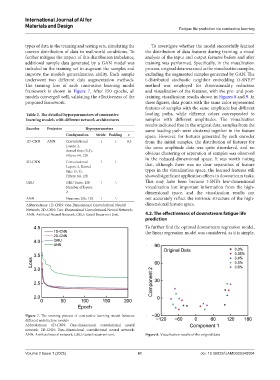
            framework is shown in  Figure  7.  After 150 epochs, all   and visualization of the features, with the pre- and post-
            models converged well, validating the effectiveness of the   training visualization results shown in Figures 8 and 9. In
            proposed framework.                                these figures, data points with the same color represented
                                                               features of samples with the same amplitude but different
            Table 2. The detailed hyperparameters of contrastive   loading paths, while different colors corresponded to
            learning models with different network architectures  samples with different amplitudes. The visualization
                                                               results indicated that in the original data, samples from the
            Encoder  Projector       Hyperparameters           same loading path were clustered together in the feature
                             Configuration  Stride Padding  τ  space. However, for features generated by each encoder
            1D-CNN   ANN     Convolutional   1    1    0.3     from  the  initial  samples,  the  distribution of  features  for
                             Layers: 2,                        the same amplitude data was quite disordered, and no
                             Kernel Size: (3,3),               obvious clustering or separation of samples was observed
                             Filters: 64, 128
            2D-CNN           Convolutional   1    1            in the reduced-dimensional space. It was worth noting
                                                               that, although there was no clear separation of feature
                             Layers: 2, Kernel
                             Size: (3, 3),                     types in the visualization space, the learned features still
                             Filters: 64, 128                  showed significant application effects in downstream tasks.
            GRU              GRU Units: 128  \    \            This may have been because t-SNE’s low-dimensional
                             Number of layers:                 visualization lost important information from the high-
                             2                                 dimensional space, and the visualization results can
            ANN              Neurons: 256, 128  \  \           not accurately reflect the intrinsic structure of the high-
            Abbreviations: 1D-CNN: One-Dimensional Convolutional Neural   dimensional feature space.
            Network; 2D-CNN: Two-Dimensional Convolutional Neural Network;
            ANN: Artificial Neural Network; GRU: Gated Recurrent Unit.  4.2. The effectiveness of downstream fatigue life
                                                               prediction

                                                               To further find the optimal downstream regression model,
                                                               the linear regression model was considered, as it is simple,


            Figure  7.  The training process of contrastive learning model between
            different architecture models
            Abbreviations: 1D-CNN:  One-dimensional  convolutional neural
            network; 2D-CNN: Two-dimensional convolutional neural network;
            ANN: Artificial neural network; GRU: Gated recurrent unit.  Figure 8. Visualization results of the original data


            Volume 2 Issue 1 (2025)                         61                        doi: 10.36922/IJAMD025040004

