


Page 36 - IJAMD-2-2
P. 36
International Journal of AI for
            Materials and Design                                           ML-driven optimization in additive manufacturing


            into supervised learning, unsupervised learning, semi-  detecting anomalies. Techniques such as k-means clustering
            supervised learning, and reinforcement learning, each   and principal component analysis have been employed to
            offering distinct advantages depending on the nature   analyze sensor data and monitor inconsistencies in layer
            of the available data and the specific manufacturing   formation and material distribution. 45
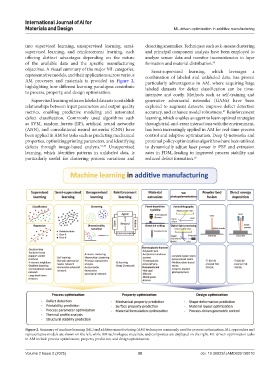
            objectives. A visual summary of the major ML categories,   Semi-supervised  learning,  which  leverages  a
            representative models, and their applications across various   combination of labeled and unlabeled data, has proven
            AM processes and materials is provided in  Figure  2,   particularly advantageous in AM, where acquiring large
            highlighting how different learning paradigms contribute   labeled datasets for defect classification can be time-
            to process, property, and design optimization.
                                                               intensive and costly. Methods such as self-training and
              Supervised learning relies on labeled datasets to establish   generative adversarial networks (GANs) have been
            relationships between input parameters and output quality   explored to augment datasets, improve  defect  detection
            metrics, enabling predictive modeling and automated   accuracy, and enhance model robustness.  Reinforcement
                                                                                                31
            defect classification. Commonly used algorithms such   learning, which enables an agent to learn optimal strategies
            as SVM, random forests (RF), artificial neural networks   through trial-and-error interactions with the environment,
            (ANN), and  convolutional neural networks  (CNN)  have   has been increasingly applied in AM for real-time process
            been applied in AM for tasks such as predicting mechanical   control and adaptive optimization. Deep Q-networks and
            properties, optimizing printing parameters, and identifying   proximal policy optimization algorithms have been utilized
            defects through image-based analysis. 31,44  Unsupervised   to dynamically adjust laser power in PBF and extrusion
            learning, which identifies patterns in unlabeled data, is   rates in FDM, leading to improved process stability and
            particularly useful  for clustering process variations and   reduced defect formation. 16


            Figure 2. Summary of machine learning (ML) and additive manufacturing (AM) techniques commonly used for process optimization. ML approaches and
            representative models are shown on the left, while AM technologies, materials, and composites are displayed on the right. ML-driven optimization tasks
            in AM include process optimization, property prediction, and design optimization.


            Volume 2 Issue 2 (2025)                         30                        doi: 10.36922/IJAMD025130010

