


Page 21 - IJB-1-1
P. 21
Manyi Wang, Jiankang He,  Yaxiong Liu,  et al.


                                                                                    [9]
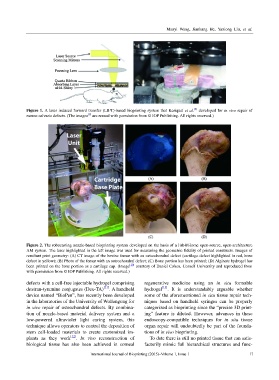
            Figure 1. A laser induced forward transfer (LIFT)-based bioprinting system that Keriquel et al.  developed for in vivo repair of
                                       [9]
            mouse calvaria defects. (The images  are reused with permission from © IOP Publishing. All rights reserved.)


            Figure 2. The robocasting nozzle-based bioprinting system developed on the basis of a Fab@Home open-source, open-architecture
            AM system. The laser highlighted in the left image was used for measuring the geometric fidelity of printed constructs. Images of
            resultant print geometry: (A) CT image of the bovine femur with an osteochondral defect (cartilage defect highlighted in red, bone
            defect in yellow); (B) Photo of the femur with an osteochondral defect; (C) Bone portion has been printed; (D) Alginate hydrogel has
            been printed on the bone portion as a cartilage cap. (Image [10]  courtesy of Daniel Cohen, Cornell University and reproduced from
            with permission from © IOP Publishing. All rights reserved.)

            defects with a cell-free injectable hydrogel comprising   regenerative  medicine using  an  in  situ  formable
            dextran-tyramine conjugates (Dex-TA) [11] . A handheld   hydrogel [13] .  It is understandably  arguable whether
            device named “BioPen”, has recently been developed   some of the aforementioned in situ tissue repair tech-
            in the laboratories of the University of Wollongong for   niques based on handheld syringes can  be properly
            in vivo repair of osteochondral defects. By combina-  categorized as bioprinting since the “precise 3D print-
            tion  of nozzle-based material  delivery  system and  a   ing”  feature is diluted. However, advances in  these
            low-powered ultraviolet light  curing system, this   endoscopy-compatible techniques for  in  situ  tissue
            technique allows operators to control the deposition of   organ repair will undoubtedly be part of the founda-
            stem  cell-loaded  materials  to  create customized  im-  tions of in vivo bioprinting.
            plants  as they  work [12] .  In  vivo  reconstruction  of   To date there is still no printed tissue that can satis-
            biological tissue has also  been  achieved in  corneal   factorily mimic  full  hierarchical  structures and  func-
                                        International Journal of Bioprinting (2015)–Volume 1, Issue 1      17

