


Page 23 - IJB-1-1
P. 23
Manyi Wang, Jiankang He,  Yaxiong Liu,  et al.

            a pulsed  laser source, a  reservoir  of cells  (donor
            container),  and  a  building  substrate onto  which  the
            cells are deposited to for construction as shown in
            Figure 1 [9,17] . It is now feasible to write multiple cell
            types synchronously with a very high printing resolu-
            tion at the micron scale [18,19] . The systems that use UV
            or other light sources are normally defined as 3D pro-
            jection  stereolithography, in  which  a  Digital  Micro-
            mirror Device (DMD) is applied to selectively project     Figure 3. Schematic of laser-based in vivo bioprinting in dentistry.
            lights onto the  photo-curable material  to build 3D
            constructs in a layer-by-layer fashion [20] . Current ste-  Two-photon polymerization  allows  for fast construc-
            reolithography-based  in  vitro  bioprinters allow  fabri-  tion of structures with submicron (hundreds of nano-
            cation of  3D bio-constructs with  micron-  and  na-  meters)  spatial  resolution  by using focused femtose-
            no-scale precision, which is helpful in the replication   cond near-infrared lasers (~800 nm wavelength) [21,22] .
            of naturally developed biological structures.  The   The limitation of current 2PP technique in bioprinting
            general drawbacks of  stereolithography-based appro-  practice is that it only allows mono-material resins to
            aches include: lower cell viability due to  heat gene-  be used, which hinders its application in the integral
            rated by the laser or exposure to UV lights;  time   fabrication of heterocellular and  multi-material tis-
            consuming due to very fine spatial resolutions of the   sues/organs. Other challenges such as stable position-
            construct; and limited available photocrosslinkable   ing of light sources (e.g., laser or UV light) and con-
            biomaterials. However, in the context of in vivo bio-  trolling units, along with accurate light focusing in an
            printing, several new challenges for  stereolithogra-  in  vivo  environment also need to be tackled.  In
            phy-based modalities may also be proposed.         addition, new  surgical  debridement techniques are
               The  first  challenge  regarding  in  vivo  laser-based   needed to allow thorough removal of crosslinkers
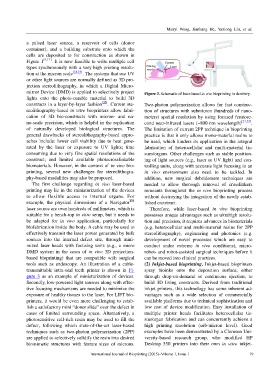
            printing may lie in the miniaturization of the devices   remnants throughout the  in  vivo  bioprinting process
            to allow flexible access to internal  organs.  For   without destroying the integration of the newly estab-
            example,  the physical  dimensions of a Navigator TM    lished construct.
            laser source are over hundreds of millimeters, which is   Therefore, while laser-based  in  vivo  bioprinting
            suitable for a bench-top in vitro setup, but it needs to   possesses unique advantages such as ultrahigh resolu-
            be  adapted  for  in  vivo  application,  particularly  for   tion and precision, it requires advances in biomaterials
            biofabrication inside the body. A cable may be used to   (e.g.  heterocellular and  multi-material resins for 2PP
            effectively transmit the laser power generated by bulk   stereolithography),  engineering and photonics  (e.g.
            sources  into  the  internal  defect site, through  mini-  development of novel processes  which  are easy to
            mized laser heads with focusing units (e.g., a micro   conduct under extreme  in  vivo  conditions), micro-
            DMD system in  the cases of  in  vivo  3D projection-   robot- and robot-assisted surgical techniques before it
            based  bioprinting) that are  compatible  with  surgical   can be moved into clinical practices.
            tools such as endoscopy.  An  illustration of a cable-   (2) Inkjet-based bioprinting. Inkjet-based bioprinters
            transmittable intra-oral teeth  printer  is shown  in  Fi-  spray  bioinks  onto the deposition surface, either
            gure 3  as an  example of  miniaturization  of devices.   through  drop-on-demand or continuous ejection, to
            Secondly, low-powered light sources along with effec-  build 3D living constructs.  Derived  from traditional
            tive focusing mechanisms are needed to minimize the   inkjet printers, this technology has some inherent ad-
            exposure of healthy tissues to the laser. For LIFT bio-  vantages  such  as  a  wide  selection  of  commercially
            printers, it would be even more challenging to estab-  available platforms due to technical sophistication and
            lish a satisfactory mini “donor slide” over the defect in   low cost of device  modification. Easy installation of
            cases of limited surrounding space.  Alternatively, a   multiple printer  heads facilitates heterocellular tis-
            photosensitive cell-rich resin  may be used to fill the   sue/organ  fabrication and  can  concurrently achieve a
            defect, following which state-of-the-art laser-based   high printing resolution (sub-micron level). Good
            techniques such  as two-photon polymerization (2PP)   examples have been demonstrated by a Clemson Uni-
            are applied to selectively solidify the resin into desired   versity-based  research  group,  who  modified  HP
            biomimetic structures with  feature sizes of microns.     Desktop 550  printers  into their own  in  vitro  inkjet-

                                        International Journal of Bioprinting (2015)–Volume 1, Issue 1      19

