


Page 27 - IJB-1-1
P. 27
Manyi Wang, Jiankang He,  Yaxiong Liu,  et al.

            room. Even the  most experienced surgeons cannot   ments are imposed  on surgical techniques, such  as
            match  a robot in terms of precision, which is a pre-   temporary generation of a printing-friendly environ-
            requisite from the perspective of nano- or micro-fab-  ment. An example of such surgical techniques can be
            rication. Robot-assisted surgery, which has been labe-  seen  in  some  arthroscopic cartilage repair surgeries
            lled as a major step up in precision and surgical quali-  when surgeons use carbon dioxide or normal air insuf-
            ty, seems to be an integral part of in vivo bioprinting   flation to facilitate the application of the gel under dry
            devices.  Currently, a few commercially available   conditions [61] .  Moreover, advanced  real-time imaging
            robot-assisted  surgical systems, such  as  the MAKO-  or geometric feedback modalities, along with compu-
                 ®
                                                         ®
            plasty  Knee Replacement System and the da Vinci    tational modeling and analysis techniques, are of equal
            Surgical System, have demonstrated their ability to   importance in the success of  in  vivo  bioprinting, for
            make surgery much  easier with perfect accuracy and   fast and accurate morphological assessment of defects
            repeatability achieved.                            and newly fabricated constructs [62–65] .
               Another significant trend in surgical technology   In summary, although the currently prevalent in vi-
            innovations is minimally invasive surgery. Compared   tro bioprinting strategies are promising in tissue/organ
            to traditional open surgery, minimally invasive surgery   fabrication, particularly for the repair and transplanta-
            has  demonstrated less post-operation  pain, less reha-  tion of vital organs such as the ones in cardiovascular
            bilitation  time,  and  higher  quality  of  life  scores [59] .   system, in vivo bioprinting will have its own inherent
            Since patients are better educated and informed thanks   advantages over the in vitro systems that include but
            to  the  Internet and  television,  demand  for services   are not limited to: in vivo tissue culture starting from
            such as  minimally  invasive surgeries is  mounting.   the biofabrication  stage  to  maximize the role of the
            Back in the  early 2000s, Burg  and Boland  already   human body in the regeneration of tissues and organs;
            pointed out the significance of combining injectable   real-time, on-site, and precise building of biological
            biomaterials with  tissue-printing technologies in  mi-  constructs to  minimize the  morphological  mismatch
            nimally  invasive  tissue  engineering  applications [60] .   between constructs and defects, and to eliminate the
            However, most of the currently-developed bioprinting   influence of physical implantation procedures on the
            systems require  open surgeries that fully  expose the   integration  of the delicate construct structures;  “one
            organs, due to oversized printing units or intrinsic li-  stop”  fabrication  and  therapy to  be delivered  to  pa-
            mitations of their working principles. Therefore, fur-  tients in the operating room, to ultimately reduce op-
            ther  miniaturizing  of device combined with novel   eration time  as  well as risks of contaminations  and
            working principles for minimally invasive in vivo bi-  occurrence  of errors due to transportation, manual
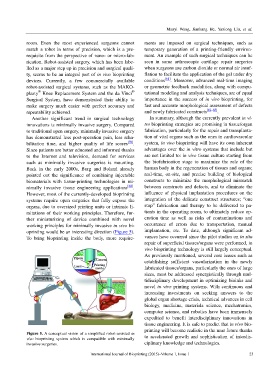
            oprinting would be an interesting direction (Figure 5).   implantation, etc. To  date, although  significant ad-
            To bring bioprinting inside the body,  more  require-   vances have occurred since the pilot studies on in situ
                                                               repair of superficial tissues/organs were performed, in
                                                               vivo bioprinting technology is still largely conceptual.
                                                               As previously mentioned, several core issues such as
                                                               establishing sufficient vascularization in the newly
                                                               fabricated tissues/organs, particularly the ones of large
                                                               sizes, must be addressed synergistically through mul-
                                                               tidisciplinary  development  in optimizing bioinks  and
                                                               novel  in  vivo  printing  systems.  With continuous and
                                                               increasing investments on seeking  answers to the
                                                               global organ shortage crisis, technical advances in cell
                                                               biology,  medicine,  materials science, mechatronics,
                                                               computer science, and robotics have been immensely
                                                               expedited  to  benefit  interdisciplinary  innovations  in
                                                               tissue engineering. It is safe to predict that in vivo bio-
                                                               printing will become realistic in the near future thanks
            Figure 5. A conceptual vision of a simplified robot-assisted in
            vivo  bioprinting  system  which  is compatible  with  minimally   to  accelerated  growth  and sophistication of interdis-
            invasive surgeries.                                ciplinary knowledge and technologies.
                                        International Journal of Bioprinting (2015)–Volume 1, Issue 1      23

