


Page 57 - IJB-1-1
P. 57
Edgar Y. S. Tan and Wai Yee Yeong

            between the layers should not occur. The wall thick-     rence pixel for the perimeter of the cavity, P.
            ness,  w, determines the  minimum  resolution of ma-                      ( ) 2
                                                                                       P
            terial deposited onto the platform. The spreading  ef-                 R =                    (2)
                                                                                       π
            fect, e, was calculated as an angle from the platform.                    4.A
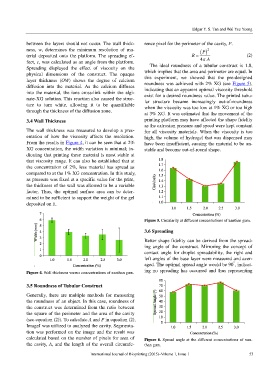
            Spreading displayed the effect of viscosity  on the   The ideal roundness of a tubular construct is 1.0,
            physical dimensions of the construct. The  opaque   which implies that the area and perimeter are equal. In
            layer thickness  (OW) shows the  degree of calcium   this experiment, we showed that the  pre-designed
            diffusion  into  the  material.  As  the  calcium  diffuses   roundness was achieved with 2% XG (see Figure 5),
            into  the material, the ions cross-link within the  algi-  indicating that an apparent optimal viscosity threshold
                                                               exist for a desired roundness value. The printed tubu-
            nate-XG solution. This reaction also caused the struc-  lar structure became increasingly out-of-roundness
            ture to turn white, allowing it to be quantifiable   when the viscosity was too low at 1% XG or too high
            through the thickness of the diffusion zone.
                                                               at 3% XG. It was estimated that the movement of the
            3.4 Wall Thickness                                 printing platform may have affected the shape fidelity
                                                               as the extrusion pressure and speed were kept constant
            The wall thickness  was  measured to develop  a pres-  for all viscosity  materials. When  the viscosity is too
            entation of how the viscosity affects the resolution.   high, the volume of hydrogel that was dispensed may
            From the results in Figure 4, it can be seen that at 2%   have been insufficient, causing the material to be un-
            XG concentration, the width variation is minimal; in-  stable and become out-of-round shape.
            dicating that printing these material is most stable at
            that viscosity range. It can also be established that at
            the concentration  of 2%, less  material has spread  as
            compared to at the 1% XG concentration. In this study,
            as pressure was fixed at a specific value for the print,
            the thickness of the wall was allowed to be a variable
            factor. Thus, the optimal surface area can  be deter-
            mined to be sufficient to support the weight of the gel
            deposited on it.


                                                               Figure 5. Circularity at different concentrations of xanthan gum.


                                                               3.6 Spreading
                                                               Better shape fidelity can be derived from the spread-
                                                               ing angle of the construct. Mirroring the concept of
                                                               contact  angle for droplet spreadability, the right and
                                                               left angles of the base layer were measured and aver-
                                                                                                     °
                                                               aged. The optimal spread angle would be 90 , indicat-
                                                               ing no spreading has occurred  and thus representing
            Figure 4. Wall thickness versus concentrations of xanthan gum.

            3.5 Roundness of Tubular Construct

            Generally, there are  multiple  methods for  measuring
            the roundness of an object. In this case, roundness of
            the construct was determined from the ratio between
            the square of the perimeter and the area of the cavity
            (see equation (2)). To calculate A and P in equation (2),
            ImageJ was utilized to analyzed the cavity. Segmenta-
            tion  was performed  on  the image and  the result was
            calculated based on the number of pixels for area of     Figure 6. Spread angle at the different concentrations of xan-
            the cavity, A, and the length of the overall circumfe-  than gum.

                                        International Journal of Bioprinting (2015)–Volume 1, Issue 1      53

