


Page 58 - IJB-1-1
P. 58
Concentric bioprinting of alginate-based tubular constructs using multi-nozzle extrusion-based technique

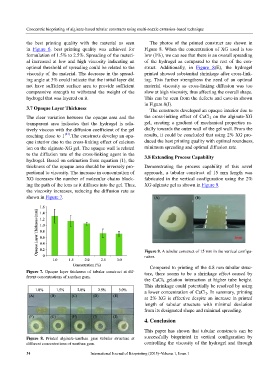
            the  best  printing  quality  with  the  material  as  seen   The photos of the printed construct are shown in
            in  Figure 6.  best printing quality was achieved for   Figure 8. When the concentration of XG used is too
            formulation of 1.5% to 2.5%. Spreading of the materi-  low (1%), we can see that there is an overall spreading
            al increased  at  low  and high viscosity indicating an   of the hydrogel as compared to the rest of the con-
            optimal threshold of spreading could be related to the   struct. Additionally, in  Figure 8(E), the hydrogel
            viscosity of the material. The decrease in the spread-  printed showed substantial shrinkage after cross-link-
            ing angle at 3% could indicate that the initial layer did   ing. This further strengthens the need of an optimal
            not have sufficient surface area to provide sufficient   material viscosity as cross-linking diffusion was too
            compressive strength to withstand the  weight of the   slow at high viscosity, thus affecting the overall shape.
            hydrogel that was layered on it.                   This can be seen from the defects and cave-in shown
                                                               in Figure 8(J).
            3.7 Opaque Layer Thickness                           The constructs developed an opaque interior due to
            The clear variation  between  the opaque area and  the   the cross-linking effect of CaCl 2  on the alginate-XG
            transparent  area  indicates  that  the  hydrogel  is  rela-  gel, creating  a gradient of mechanical properties ra-
            tively viscous with the diffusion coefficient of the gel   dially towards the outer wall of the gel wall. From the
            reaching close to 1 [41] .The constructs develop an opa-  results, it could be concluded that using 2% XG pro-
            que interior due to the cross-linking effect of calcium   duced the best printing quality with optimal roundness,
            ion on the alginate-XG gel. The opaque wall is related   minimum spreading and optimal diffusion rate.
            to the diffusion rate of the cross-linking agent in the   3.8 Extending Process Capability
            hydrogel. Based on estimation from equation (1), the
            thickness of the opaque area should be inversely pro-  Demonstrating the  process capability of this novel
            portional to viscosity. The increase in concentration of   approach, a tubular  construct of 15  mm length was
            XG increases the number of molecular chains block-  fabricated  in  the vertical configuration  using  the 2%
            ing the path of the ions as it diffuses into the gel. Thus,   XG-alginate gel as shown in Figure 9.
            the viscosity increases, reducing the diffusion rate as
            shown in Figure 7.


                                                               Figure 9. A tubular construct of 15 mm in the vertical configu-
                                                               ration.


                                                                 Compared to printing of the 4.8 mm tubular struc-
            Figure  7.  Opaque  layer  thickness  of tubular construct at  dif-  ture, there seems to  be a shrinkage effect caused  by
            ferent concentrations of xanthan gum.
                                                               the CaCl 2  gelation interaction at higher tube height.
                                                               This shrinkage could potentially be resolved by using
                                                               a lower concentration of CaCl 2. In summary, printing
                                                               at 2% XG is effective despite an  increase in  printed
                                                               length of tubular structure  with  minimal deviation
                                                               from its designated shape and minimal spreading.
                                                               4. Conclusion


                                                               This paper has shown that tubular constructs can be
                                                               successfully bioprinted in vertical configuration  by
            Figure  8.  Printed  alginate-xanthan  gum  tubular structure at
            different concentrations of xanthan gum.           controlling the viscosity of the hydrogel and through
            54                          International Journal of Bioprinting (2015)–Volume 1, Issue 1

