


Page 63 - IJB-1-1
P. 63
Ramya Bhuthalingam,  Pei Qi Lim,  Scott A.  Irvine,  et al.

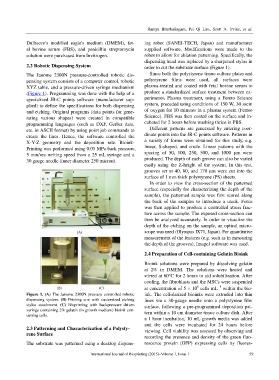
            Dulbecco's modified  eagle's medium  (DMEM), fet-  ing robot (SANEI-TECH, Japan) and manufacturer
            al bovine  serum  (FBS),  and  penicillin  streptomycin   supplied software. Modifications  were  made  to the
            solution were purchased from Invitrogen.           robot to allow for ablation patterning. Specifically, the
                                                               dispensing head was replaced by a sharpened stylus in
            2.2 Robotic Dispensing System                      order to cut the substrate surface (Figure 1).

            The Janome 2300N pressure-controlled robotic dis-    Since both the polystyrene tissue culture plates and
            pensing system consists of a computer control, robotic   polystyrene films were used, all surfaces were
            XYZ table, and a pressure-driven syringe mechanism   plasma-treated and coated with fetal bovine serum to
            (Figure 1). Programming was done with the help of a   produce a standardized surface treatment between ex-
            specialized  JR-C points software (manufacturer sup-  periments.  Plasma treatment, using  a Femto  Science
            plied) to define the specifications for both dispensing   system, preceded using conditions of 150 W, 30 sscm
            and etching. Original programs (data points for gene-  of oxygen for 10 minutes in a plasma system (Femto
            rating various shapes)  were created  in  compatible   Science). FBS was then coated on the surface and in-
            programming languages (such  as  DXF, Gerber data,   cubated for 2 hours before washing thrice in PBS.
            etc. in ASCII format) by using point job commands to   Different patterns are generated  by  entering  coor-
            create the lines. Hence, the software controlled  the   dinate points into the JR-C points software. Patterns in
            X-Y-Z geometry and the deposition rate.  Bioink-   a variety of forms were obtained for this study, e.g.
            Printing was performed using 0.05 MPa back pressure,   linear, S-shaped, and circle. Linear patterns with the
            5 mm/sec writing speed from a 25 mL syringe and a   spacing of 50, 100, 250, 500, and 1000  μm  were
            30 gauge needle (inner diameter 250 micron).       produced. The depth of each groove can also be varied
                                                               easily using  the Z-height of the system. In  this test,
                                                               grooves set at 40, 80, and 170 μm were cut into the
                                                               surface of 1 mm thick polystyrene (PS) sheets.
                                                                 In order to view the cross-section of the patterned
                                                               surface (especially for characterizing the depth of the
                                                               sample), the patterned sample was first scored along
                                                               the back of the samples to introduce a  crack. Force
                                                               was then applied to produce a controlled stress frac-
                                                               ture across the sample. The exposed cross-section can
                                                               then be analyzed accurately. In order to visualize the
                                                               depth of the etching on the sample, an optical micro-
                                                               scope was used (Olympus IX71, Japan). For quantitative
                                                               measurement of the features (e.g. such as in measuring
                                                               the depth of the grooves), ImageJ software was used.
                                                               2.4 Preparation of Cell-containing Gelatin Bioink

                                                               Bioink solutions were prepared by dissolving gelatin
                                                               at 2% in DMEM.  The solutions were heated and
                                                               stirred at 60°C for 2 hours to aid solubilization. After
                                                               cooling, the fibroblasts and the MSCs were suspended
                                                                                     6
                                                                                              −1
                                                               at concentration of 5 × 10  cells mL  within the bio-

            Figure 1. (A) The Janome 2300N pressure controlled robotic   ink. The cellularized bioinks were extruded into thin
            dispensing  system.  (B)  Printing arm  with  customized  etching   lines via a 30-gauge needle onto a polystyrene film
            stylus attachment.  (C)  Bioprinting  with backpressure driven   surface, following  a pre-programmed deposition pat-
            syringe containing 2% gelatin (in growth medium) bioink con-
            taining cells.                                     tern within a 10 cm diameter tissue culture dish. After
                                                               a 1 hour incubation, 10 mL growth media was added
                                                               and  the cells  were incubated  for 24  hours before
            2.3 Patterning and Characterization of a Polysty-  viewing. Cell viability was assessed by observing and
            rene Surface
                                                               recording the presence and density of the green fluo-
            The substrate was patterned using a desktop dispens-  rescence protein  (GFP)  expressing cells by fluores-

                                        International Journal of Bioprinting (2015)–Volume 1, Issue 1      59

