


Page 66 - IJB-1-1
P. 66
A novel 3D printing method for cell alignment and differentiation

            distance between the grooves of 100 µm was applied.

               As  mentioned in the introduction, the purpose of
            pre-etching grooves before cell seeding was to allow
            the promotion of cell anisotropy and the regulation of
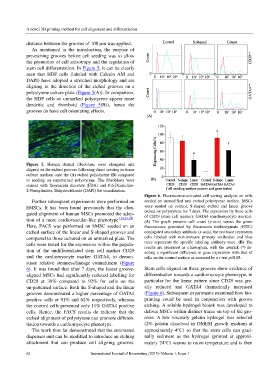
            stem cell differentiation. In Figure 5, it can be clearly
            seen  that  HDF  cells (labeled  with  Calcein  AM and
            DAPI) have adopted a stretched morphology and are
            aligning in the direction of the etched grooves on a
            polystyrene culture plate (Figure 5(A)). In comparison,
            the HDF cells on unmarked polystyrene appear more
            dendritic and rhomboid (Figure  5(B)), hence  the
            grooves do have cell orientating effects.


            Figure  5.  Human  dermal  fibroblasts  were  elongated  and
            aligned on the etched grooves following direct seeding in tissue
            culture medium onto the (A) etched polystyrene (B) compared
            to  seeding  on  unpatterned  polystyrene.  The fibroblasts  were
            stained  with  fluorescein  diacetate  (FDA)  and  4',6-Diamidino-
            2-Phenylindole, Dihydrochloride (DAPI) for visualization.
                                                               Figure 6. Fluorescence-activated cell sorting analysis on cells
               Further subsequent experiments were performed on   seeded on unmodified  and etched  polystyrene surface.  MSCs
            hMSCs. It has  been found  previously that the elon-  were seeded  on  control,  S-shaped  etched  and linear  groove
            gated alignment of human MSCs promoted the adop-   etched on polystyrene for 7 days. The expression by these cells
                                                               of CD29 (stem cell marker), GATA4 (cardiomyocyte marker).
            tion of a  more cardiovascular-like phenotype  [18,23,24] .   (A)  The graph presents cell count (y-axis) versus  the green
            Here, FACS was performed on hMSC seeded on an      fluorescence generated  by  fluorescein  isothiocyanate (FITC)
            etched surface of the linear and S-shaped grooves and   conjugated secondary antibody (x-axis), the red trace represents
            compared to those cultured on an unmarked plate. The   cells  labeled  with  non-immune primary  antibodies and  blue
            cells were tested for the expression within the popula-  trace represents the  specific labeling  antibody trace.  (B)  The
                                                               results are presented as a histogram, with the asterick (*) de-
            tion  of  the  undifferentiated  stem  cell  marker  CD29   noting a significant difference in gene expression with that of
            and the  cardiomyocyte  marker GATA4, to demon-    cells on the control surface as assessed by a t-test p<0.05.
            strate  relative  stemness/lineage  commitment  (Figure
            6). It was found that after 7 days, the linear groove-   Stem cells aligned on these grooves show evidence of
            aligned MSCs had significantly reduced labelling for   differentiation towards a cardiomyocyte phenotype, in
            CD29 at 39% compared to 92% for  cells on the      particular for the linear pattern since CD29 was gre-
            un-patterned surface. Both the S-shaped and the linear   atly reduced  and  GATA4 dramatically increased
            grooves demonstrated a higher percentage of GATA4   (Figure 6). Subsequent experiments examined how bio-
            positive cells at 91% and  62% respectively, whereas   printing could  be used  in conjunction  with groove
            the control cells presented only 11% GATA4 positive   etching. A soluble hydrogel bioink was developed to
            cells.  Hence,  the  FACS results  do  indicate  that  the   deliver MSCs within distinct traces on top of the gro-
            etched alignment of polystyrene can promote differen-  oves.  A low viscosity  gelatin  hydrogel was selected
            tiation towards a cardiomyocyte phenotype.         (2% gelatin dissolved in DMEM growth  medium  at
               The work thus far demonstrated that the automated   approximately 4°C)  so  that the stem  cells can  grad-
            dispenser unit can be modified to introduce an etching   ually sediment as the hydrogel (printed at approxi-
            attachment  that  can  produce  cell  aligning  grooves.     mately 24°C) warms to room temperature and is then

            62                          International Journal of Bioprinting (2015)–Volume 1, Issue 1

