


Page 64 - IJB-1-1
P. 64
A novel 3D printing method for cell alignment and differentiation

            cence microscopy.                                  minutes, then permeabilized with 0.25% triton X 100
                                                               for 10 minutes and  washed with PBS, then blocked
            2.5 Evaluation of Patterned Surface for Cell Alignment   with 0.5% bovine serum albumin (BSA) for 30

                                                          5
            The cells were seeded  with  a density of 3  ×  10    minutes, all performed at 4°C. Cells were then incu-
                   2
            cells/cm  and left to grow for 2 days. For an evaluation   bated with  primary antibodies for 30 minutes, fol-
            of cell orientation, the samples are stained with fluo-  lowed by the FITC labeled secondary antibody for 30
            rescein diacetate (FDA) and 4',6-Diamidino-2-PheNy-   minutes. Cells were finally re-suspended in PBS and
            lindole, Dihydrochloride  (DAPI)  nuclear stain. The   analyzed for  marker expression with the Millipore
            cells  are then  observed  under a  fluorescence micro-  GUAVA easycyte HT flow cytometer.
            scope (Olympus IX71, Japan).
                                                               3. Results
            2.6 Cardiac Expression Study for Aligned Cells on
            a Patterned Surface                                The back pressure-assisted dispenser from the robotic
                                                               dispensing unit could be easily substituted from the
            Polystyrene films (2  ×  2  cm) were  patterned  linear   printing  arm  and  replaced  with a  sharp  needle  that
            grooves with 100  µm  spacing and were seeded with   could  etch  distinct  grooves  into  polystyrene  sheets
                          5
                                  2
            hMSC at 3 × 10  cells/cm .                         (Figure 1(A), (B), (C)). The apparatus could then be
               For FACS, hMSCs were seeded for 7 days on the   programmed  to  print  complex  patterns  by  creating
            polystyrene  surfaces before intracellular staining for   straight  lines,  and  sinusoidal  S-shaped  and  circular
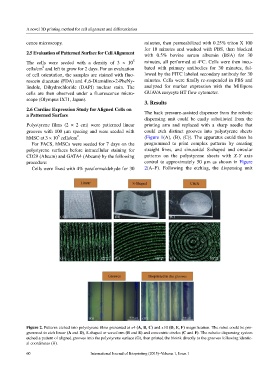
            CD29 (Abcam) and GATA4 (Abcam) by the following    patterns on  the polystyrene sheets with  X-Y  axis
            procedure:                                         control to approximately 50  µm  as shown in  Figure
               Cells were fixed with 4% paraformaldehyde for 30   2(A–F).  Following  the  etching,  the  dispensing  unit


            Figure 2. Patterns etched into polystyrene films presented at x4 (A, B, C) and x10 (D, E, F) magnification. The robot could be pro-
            grammed to etch linear (A and D), S-shaped or waveform (B and E) and concentric circles (C and F). The robotic dispensing system
            etched a pattern of aligned grooves into the polystyrene surface (G), then printed the bioink directly to the grooves following identic-
            al coordinates (H).

            60                          International Journal of Bioprinting (2015)–Volume 1, Issue 1

