


Page 67 - IJB-1-1
P. 67
Ramya Bhuthalingam,  Pei Qi Lim,  Scott A.  Irvine,  et al.

            incubated  at 37°C. The stem  cells sense the features   onto these grooves. The printed cells can sense the
            and then become stretched and aligned in the direction   grooves and respond by elongating and aligning with
            of the feature. Figure 7(A) demonstrates the high den-  them. There is the potential of combining both proce-
            sity of cells printed directly on to the etched grooves,   sses in the same printing head to produce cell aligning
            as can  be viewed  by the DAPI stained nuclei.  The   grooves and simultaneously seed the cells directly on
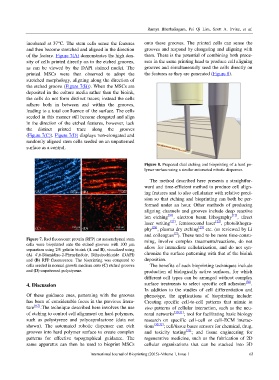
            printed MSCs were then observed to adopt the       the features as they are generated (Figure 8).
            stretched morphology, aligning along the direction of
            the etched groove (Figure 7(B)). When the MSCs are
            deposited in the culture media rather than the bioink,
            the cells do not form distinct traces; instead the cells
            adhere both in between and within the grooves,
            leading to a total confluence of the surface. The cells
            seeded in this manner still become elongated and align
            in the direction  of the etched  features, however, lack
            the distinct printed trace along  the grooves
            (Figure 7(C)). Figure 7(D) displays non-elongated and
            randomly aligned stem cells seeded on an unpatterned
            surface as a control.


                                                               Figure 8. Proposed dual etching and bioprinting of a hard po-
                                                               lymer surface using a similar automated robotic dispenser.

                                                                 The method  described  here presents a  straightfor-
                                                               ward and time-efficient method to produce cell align-
                                                               ing features and to also cellularize with relative preci-
                                                               sion so that etching and bioprinting can both be per-
                                                               formed  under  an hour.  Other methods of  producing
                                                               aligning channels and grooves include deep  reactive
                                                               ion etching [26] , electron beam lithography [12] , direct
                                                               laser writing [27] , femtosecond  laser [22] , photolithogra-
                                                               phy [28] , plasma dry etching [29]  etc. (as reviewed by Li
                                                                           [7]
                                                               and colleagues ). These tend to be more time-consu-
            Figure 7. Red fluorescent protein (RFP) rat mesenchymal stem   ming, involve complex treatments/reactions, do not
            cells were bioprinted  onto  the etched grooves with 100 µm
            separation using 2% gelatin bioink (A and B), visualized using   allow for immediate cellularization, and do not syn-
            (A)  4',6-Diamidino-2-Phenylindole, Dihydrochloride  (DAPI)   chronize the surface patterning with that of the bioink
            and  (B)  RFP fluorescence.  The bioprinting  was compared  to   deposition.
            cells seeded in normal growth medium onto (C) etched grooves    The benefits of such bioprinting techniques include
            and (D) unpatterned polystyrene.                   production  of biologically active surfaces, for which
                                                               different cell types can be arranged without complex

            4. Discussion                                      surface treatments to  select specific cell adhesion [30] .
                                                               In addition to  the studies of cell differentiation  and
            Of these guidance cues, patterning with the grooves   phenotype, the applications of bioprinting include:
            has been of considerable focus in the previous litera-  Creating  specific cell-to-cell patterns that  mimic  in
            ture [6,7] .The technique described here involves the use   vivo patterns of cellular interaction, such as the neu-
            of etching to control cell alignment on hard polymers,   ronal networks [30,31] ; tool for facilitating basic biology
            such  as  polystyrene  and  polycaprolactone  (data  not   research  on  specific cell–cell or cell–ECM interac-
            shown). The automated  robotic dispenser can  etch   tions [30,32] ; cell/tissue bases sensors for chemical, drug,
            grooves into hard polymer surface to create complex   and toxicity testing [33] ; and tissue engineering for
            patterns  for effective topographical  guidance.  The   regenerative  medicine, such  as the fabrication  of 2D
            same  apparatus  can then  be used  to  bioprint  MSCs   cellular organizations that can  be stacked  into  3D
                                        International Journal of Bioprinting (2015)–Volume 1, Issue 1      63

