


Page 56 - IJB-1-1
P. 56
Concentric bioprinting of alginate-based tubular constructs using multi-nozzle extrusion-based technique

            complete gelation  after  printing. Although  some re-
            search has been done on cross-linking alginate gels
            simultaneously during printing, the process was
            shown to be relatively slow as they were done in the
            cross-linking solution or on the surface of the alginate
            solution. Thus, the resolution of the fabricated struc-
            ture is influenced by parameters such as surface ten-
            sion and the speed of the extrusion, rendering a
            non-direct way to control resolution.
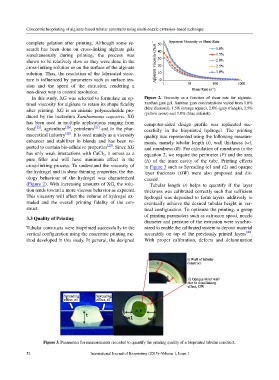
               In this study, XG was selected to formulate an op-  Figure  2.  Viscosity  as  a function  of shear  rate for alginate-
            timal viscosity for alginate to retain its shape fidelity   xanthan gum gel. Xanthan gum concentrations varied from 1.0%
            after  printing. XG is an anionic polysaccharide pro-  (blue diamond), 1.5% (orange square), 2.0% (grey triangle), 2.5%
                                                               (yellow cross) and 3.0% (blue asterisk).
            duced by the  bacterium  Xanthomonas capestris. XG
            has been used in  multiple applications ranging from   computer-aided  design  profile was  replicated  suc-
            food [35] , agriculture [36] , petroleum [37]  and in the phar-  cessfully in the bioprinted hydrogel. The printing
            maceutical industry [38] . It is used mainly as a viscosity   quality was represented using the following measure-
            enhancer  and  stabilizer  in  blends  and  has  been  re-  ments, namely  tubular length (t), wall thickness (w),
            ported to contain bio-adhesive properties [39] . Since XG   and roundness (R). For calculation of roundness in the
            has only weak interactions with CaCl 2, it serves as a   equation 2, we require the perimeter (P) and the area
            pure  filler  and  will have  minimum  effect  in  the   (A) of  the  inner cavity of  the  tube. Printing effects
            cross-linking process. To understand the  viscosity of   in Figure 3 such as Spreading (e1 and e2) and opaque
            the hydrogel and its shear thinning properties, the rhe-  layer thickness (OW) were also proposed and dis-
            ology  behaviour  of the hydrogel was  characterized   cussed.
            (Figure 2). With increasing amounts of XG, the solu-  Tubular  length  (t) helps to quantify  if  the  layer
            tion tends toward a more viscous behavior as expected.   thickness was calibrated correctly such that sufficient
            This viscosity will affect the volume of hydrogel ex-  hydrogel was deposited to form layers  additively to
            truded  and  the  overall  printing  fidelity  of  the  con-  eventually  achieve the desired tubular height in ver-
            struct.                                            tical configuration. To optimize the printing, a group
                                                               of printing parameters such as extrusion speed, nozzle
            3.3 Quality of Printing
                                                               diameter and pressure of the extrusion were synchro-
            Tubular constructs were bioprinted successfully in the   nized to enable the calibrated system to deposit material
            vertical configuration using the concentric printing me-   accurately  on top of the previously printed layers [40] .
            thod developed in this study. In general, the designed     With proper calibration, defects and delamination


                    Figure 3. Parameters for measurements recorded to quantify the printing quality of a bioprinted tubular construct.


            52                          International Journal of Bioprinting (2015)–Volume 1, Issue 1

