


Page 85 - IJB-1-1
P. 85
Libiao Liu and Xiaohong Wang

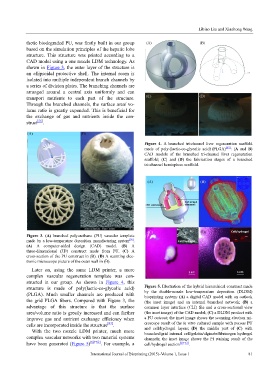
            thetic biodegraded PU, was firstly built in our group
            based on the simulation principles of the hepatic lobe
            structure. This structure was printed according to a
            CAD model using a one nozzle LDM technology. As
            shown in Figure 3, the outer layer of the structure is
            an  ellipsoidal protective  shell.  The  internal  room  is
            isolated into multiple independent branch channels by
            a series of division plates. The branching channels are
            arranged  around  a  central  axis  uniformly and  can
            transport  nutrients  to  each  part  of the  structure.
            Through the branched channels, the surface area/ vo-
            lume ratio is greatly expanded. This is beneficial for
            the  exchange of  gas and  nutrients  inside  the con-
            struct [56] .


                                                               Figure 4.  A branched tri-channel liver regeneration  scaffold
                                                               made of  poly (lactic-co-glycolic acid) (PLGA) [63] :  (A  and  B)
                                                               CAD  models of  the  branched tri-channel liver  regeneration
                                                               scaffold; (C)  and  (D)  the fabrication stages of a  branched
                                                               tri-channel hemisphere scaffold.


            Figure  3.  (A)  branched  polyurethane (PU) vascular template
                                                        [56]
            made by a low-temperature  deposition manufacturing system .
            (A)  A  computer-aided design (CAD)  model.  (B)  A
            three-dimensional (3D) construct made from PU.  (C)  A
            cross-section of the PU construct in (B). (D) A scanning elec-
            tronic microscope picture of the outer wall in (B).

               Later on, using  the same  LDM  printer,  a more
            complex  vascular regeneration  template was con-
            structed in our group. As  shown in  Figure  4,  this
            structure is  made of  poly(lactic-co-glycolic acid)   Figure 5. Illustration of the hybrid hierarchical construct made
            (PLGA). Much  smaller channels  are produced  with   by the double-nozzle low-temperature deposition (DLDM)
                                                               bioprinting system: (A) a digital CAD model with an outlook
            the grid PLGA fibers.  Compared with  Figure  3, the   (the inset image) and an internal branched  network;  (B)  a
            advantage  of  this  structure is  that  the  surface   common layer interface (CLI)  file and a cross-sectional view
            area/volume ratio is greatly increased and can further   (the inset image) of the CAD model; (C) a DLDM product with
            improve gas and nutrient exchange  efficiency  when   a PU outcoat; the inset image shows the scanning electron mi-
            cells are incorporated inside the structure [63] .   croscope result of the in vitro cultured sample with porous PU
               With the  two nozzle LDM  printer, much more    and cell/hydrogel layers;  (D)  the middle part of  (C)  with
                                                               branched/grid internal cell/gelatin/alginate/fibrinogen hydrogel
            complex vascular networks with two material systems   channels; the inset image shows the  PI staining result of the
            have been generated (Figure 5) [60–62] . For example, a     cell/hydrogel section [60–63] .

                                        International Journal of Bioprinting (2015)–Volume 1, Issue 1      81

