


Page 83 - IJB-1-1
P. 83
Libiao Liu and Xiaohong Wang

                                                               mainly  two branches,  with  only a few branches  that
                                                               are trigeminal. It is very hard for the CCO method to
                                                               mimic the  natural vascular  systems  completely.  The
                                                               dichotomous branching can be determined as the basic
                                                               structure of biomimetic vessel. Based on the physical
                                                               laws  and  conditions  to  establish  the  corresponding
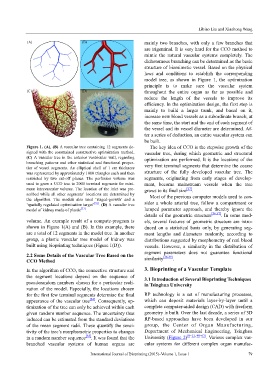
                                                               model  tree, as shown in  Figure 1, the  optimization
                                                               principle is to  make sure the vascular system
                                                               throughout the  entire organ as far as possible and
                                                               reduce the length of the vessels to improve its
                                                               efficiency. In the optimization design, the first step is
                                                               mainly  to build a larger  trunk, and  based on it,
                                                               increase new blood vessels as a subordinate branch; at
                                                               the same time, the start and the end of each segment of
                                                               the vessel and its vessel diameter are determined. Af-
                                                               ter a series of deduction, an entire vascular system can
                                                               be built.
            Figure 1. (A), (B) A vascular tree containing 12 segments de-  The key idea of CCO is the stepwise growth of the
            signed with the constrained constructive optimization method.   vascular tree, during which geometric and structural
            (C) A vascular tree in the anterior ventricular wall, regarding   optimization are performed. It is the locations of the
            branching patterns and other statistical and functional proper-
            ties of vessel segments.  An elliptical shell of 1 cm thickness   very first terminal segments that determine the coarse
            was represented by approximately 1000 triangles each and then   structure of the fully developed vascular tree.  The
            restricted by two cut-off planes. The perfusion volume  was   segments, originating from early stages of develop-
            used to grow a CCO tree to 2000 terminal segments for mini-  ment,  become  mainstream vessels when  the tree
            mum intravascular volume. The location of the inlet was pre-  grows to its final size [27] .
            scribed while all other segments’ locations are determined by
            the algorithm. The  models also used ‘staged-growth’ and a   Most of the previous computer models used to con-
            ‘spatially regulated optimization target’ [32] . (D) A vascular tree   sider  a  whole  arterial  tree,  follow  a  compartment  or
            model of kidney made of plastic [33] .             lumped parameter approach, and thereby ignore the
                                                               details of the geometric structure [36,37] . In some mod-
            volume. An example result of a compute-program is   els,  several features of geometric structure are intro-
            shown in Figure 1(A) and (B). In this example, there   duced on  a statistical basis only, by generating seg-
            are a total of 12 segments in the model tree. In another   ment lengths and  diameters randomly, according to
            group, a  plastic  vascular tree model of  kidney  was   distributions suggested by morphometry of real blood
            built using bioprinting techniques (Figure 1(D)).   vessels.  However,  a similarity in  the distribution  of
                                                               segment parameters does  not guarantee functional
            2.2 Some Details of the Vascular Tree Based on the         [38,39]
            CCO Method                                         similarity  .

            In the algorithm of CCO, the connective structure and   3. Bioprinting of a Vascular Template
            the segment locations depend on the sequence of    3.1 Introduction of Several Bioprinting Techniques
            pseudorandom numbers chosen for a particular reali-  in Tsinghua University
            zation of the model. Especially, the locations chosen
            for the first few terminal segments determine the final   RP technology is a set of manufacturing processes,
            appearance of the vascular tree [34] . Consequently, op-  which can deposit  materials layer-by-layer until a
            timization of the tree can only be achieved within each   complete computer-aided design (CAD) with freeform
            given random number sequence. The uncertainty thus   geometry is built. Over the last decade, a series of 3D
            induced can be estimated from the standard deviations   RP-based approaches have been developed  in  our
            of the mean segment radii. These quantify the sensi-  group,  the Center  of  Organ Manufacturing,
            tivity of the tree’s morphometric properties to changes   Department of Mechanical  Engineering, Tsinghua
            in a random number sequence [35] . It was found that the   University (Figure 2) [8–11, 40–63] . Various complex vas-
            branched  vascular systems of  human  organs are   cular  systems  for different complex organ  manufac-

                                        International Journal of Bioprinting (2015)–Volume 1, Issue 1      79

