


Page 102 - IJB-10-1
P. 102
International Journal of Bioprinting                                3D bioprinting for musculoskeletal system


            exploring molecular mechanisms and screening drug   chronic and degenerative disease that is increasingly
            candidates for MSDs (Table 5). Metabolic bone disease   prevalent in aging and obese populations.  Little is
                                                                                                    200
            (MBD) encompasses a broad spectrum of conditions   known in the case of the molecular mechanisms of the
            characterized by abnormalities in bone mineral or bone   onset and progression of osteoarthritis, and thus, most
            matrix, affecting over 500 million people worldwide.    current treatments for osteoarthritis alleviate symptoms
                                                         196
            Among them, osteoporosis is the most common and    without repairing the cartilage tissues. Understanding the
            associated with high risk of fractures.  To better understand   interaction between osteochondral tissues, symptoms,
                                        197
            the bone metabolic pathologies and to develop therapeutic   and related signaling  pathways  will  provide  better
            drugs, in vitro models of bone tissue are urgently needed.   options for the treatment of osteoarthritis. Toward this,
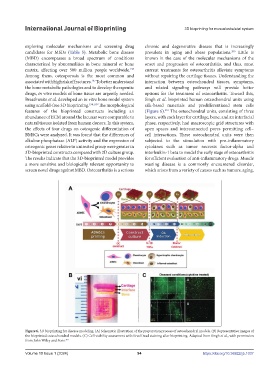
            Breathwaite et al. developed an in vitro bone model system   Singh et al. bioprinted human osteochondral units using
            using scaffold-free 3D bioprinting. 198,199  The morphological   silk-based materials and predifferentiated stem cells
            features  of  the bioprinted  constructs  including  an   (Figure 6).  The osteochondral units, consisting of three
                                                                       201
            abundance of ECM around the lacunar were comparable to   layers, with each layer for cartilage, bone, and an interfacial
            natural tissues isolated from human donors. In this system,   phase, respectively, had macroscopic grid structures with
            the effects of four drugs on osteogenic differentiation of   open spaces and interconnected pores permitting cell–
            BMSCs were analyzed. It was found that the differences of   cell interactions. These osteochondral units were then
            alkaline phosphatase (ALP) activity and the expression of   subjected  to  the  stimulation  with  pro-inflammatory
            osteogenic genes relative to untreated group were greater in   cytokines such as tumor necrosis factor-alpha and
            3D-bioprinted constructs compared with 2D culture group.   interleukin-1 beta to model the early stage of osteoarthritis
            The results indicate that the 3D-bioprinted model provides   for efficient evaluation of anti-inflammatory drugs. Muscle
            a more sensitive and biologically relevant opportunity to   wasting disease is a commonly encountered disorder,
            screen novel drugs against MBD. Osteoarthritis is a serious   which arises from a variety of causes such as tumors, aging,


            Figure 6. 3D bioprinting for disease modeling. (A) Schematic illustration of the preparation process of osteochondral models. (B) Representative images of
            the bioprinted osteochondral models. (C) Cell viability assessment with Live/Dead staining after bioprinting. Adapted from Singh et al., with permission
            from John Wiley and Sons. 201

            Volume 10 Issue 1 (2024)                        94                          https://doi.org/10.36922/ijb.1037

