


Page 105 - IJB-2-2
P. 105
Kenichi Arai, Yoshinari Tsukamoto, Hirotoshi Yoshida,  et al.


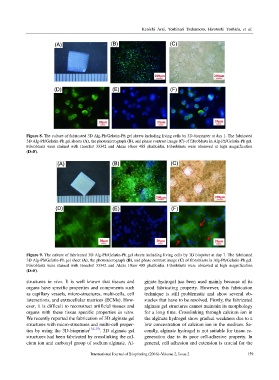
            Figure 8. The culture of fabricated 3D Alg-Ph/Gelatin-Ph gel sheets including living cells by 3D-bioprinter at day 1. The fabricated
            3D Alg-Ph/Gelatin-Ph gel sheets (A), the photomicrograph (B), and phase contrast image (C) of fibroblasts in Alg-Ph/Gelatin-Ph gel.
            Fibroblasts were stained with Hoechst 33342 and Alexa Fluor  488  phalloidin. Fibroblasts were observed at high magnification
            (D–F).


            Figure 9. The culture of fabricated 3D Alg-Ph/Gelatin-Ph gel sheets including living cells by 3D biopriter at day 7. The fabricated
            3D Alg-Ph/Gelatin-Ph gel sheet (A), the photomicrograph (B), and phase contrast image (C) of fibroblasts in Alg-Ph/Gelatin-Ph gel.
            Fibroblasts were stained with Hoechst 33342 and Alexa Fluor  488  phalloidin. Fibroblasts were observed at high magnification
            (D–F).

            structures  in  vivo. It is  well known that tissues and   ginate hydrogel has been used mainly because of its
            organs have specific properties and components such   good fabricating property.  However, this fabrication
            as capillary vessels, micro-structures, multi-cells, cell   technique is still problematic and show several ob-
            interactions, and extracellular matrices (ECMs). How-  stacles that have to be resolved. Firstly, the fabricated
            ever, it is difficult to reconstruct artificial tissues and   alginate gel structures cannot maintain its morphology
            organs  with  these  tissue  specific properties  in  vitro.   for a long time. Crosslinking through calcium ion in
            We recently reported the fabrication of 3D alginate gel   the alginate hydrogel show gradual weakness due to a
            structures with micro-structures and multi-cell proper-  low concentration of calcium ion in the medium. Se-
            ties by using the 3D-bioprinter [14–15] . 3D alginate gel   condly, alginate hydrogel is not suitable for tissue re-
            structures had been fabricated by crosslinking the cal-  generation due to its poor  cell-adhesive property.  In
            cium ion and carboxyl group of sodium alginate. Al-  general, cell adhesion and extension is crucial for the

                                        International Journal of Bioprinting (2016)–Volume 2, Issue 2      159

