


Page 102 - IJB-2-2
P. 102
The development of cell-adhesive hydrogel for 3D printing


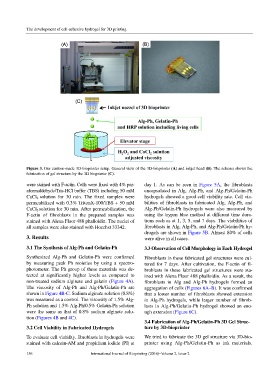
            Figure 3. Our custom-made 3D-bioprinter setup. General view of the 3D-bioprinter (A) and inkjet head (B). The schema shows the
            fabrication of gel structure by the 3D bioprinter (C).

            were stained with F-actin. Cells were fixed with 4% par-  day  1.  As  can be  seen in  Figure  5A,  the  fibroblasts
            aformaldehyde/Tris-HCl buffer (TBS) including 50 mM   encapsulated  in  Alg,  Alg-Ph,  and  Alg-Ph/Gelatin-Ph
            CaCl 2  solution for 30 min. The fixed samples  were   hydrogels showed a good cell viability rate. Cell via-
            permeabilized with 0.3% TritonX-100/TBS + 50 mM    bilities of  fibroblasts in  fabricated  Alg,  Alg-Ph, and
            CaCl 2 solution for 30 min. After permeabilization, the   Alg-Ph/Gelatin-Ph  hydrogels  were  also  measured  by
            F-actin  of fibroblasts in  the prepared  samples was   using the trypan blue method at different time  dura-
            stained with Alexa Fluor 488 phalloidin. The nuclei of   tions such as at 1, 3, 5, and 7 days. The viabilities of
            all samples were also stained with Hoechst 33342.   fibroblasts in Alg, Alg-Ph, and Alg-Ph/Gelatin-Ph hy-
                                                               drogels are shown in Figure 5B. Almost 80% of cells
            3. Results                                         were alive in all cases.

            3.1 The Synthesis of Alg-Ph and Gelatin-Ph         3.3 Observation of Cell Morphology in Each Hydrogel
            Synthesized  Alg-Ph  and Gelatin-Ph  were confirmed   Fibroblasts in these fabricated gel structures were cul-
            by measuring  peak  Ph moieties  by  using a  spectro-  tured for 7 days. After cultivation, the F-actin  of fi-
            photometer. The Ph group of these materials was de-  broblasts in  these fabricated  gel structures were sta-
            tected  at significantly higher levels as compared  to   ined with Alexa Fluor 488 phalloidin. As a result, the
            non-treated  sodium alginate and gelatin  (Figure 4A).   fibroblasts  in  Alg and Alg-Ph  hydrogels formed an
            The viscosity of Alg-Ph and Alg-Ph/Gelatin-Ph  are   aggregation of cells (Figures 6A–B). It was confirmed
            shown in Figure 4B-C. Sodium alginate solution (0.8%)   that a lower number of fibroblasts showed extension
            was measured as a control. The viscosity of 1.5% Alg-   in  Alg-Ph hydrogels, while larger number of fibrob-
            Ph solution and 1.5% Alg-Ph/0.5% Gelatin-Ph solution   lasts  in  Alg-Ph/Gelatin-Ph  hydrogel  showed  an  eno-
            were the same as that of 0.8% sodium alginate solu-  ugh extension (Figure 6C).
            tion (Figures 4B and 4C).
                                                               3.4 Fabrication of Alg-Ph/Gelatin-Ph 3D Gel Struc-
            3.2 Cell Viability in Fabricated Hydrogels         ture by 3D-bioprinter

            To evaluate cell viability, fibroblasts in hydrogels were   We tried to fabricate the 3D gel structure via 3D-bio-
            stained with calcein-AM and propidium iodide (PI) at   printer  using Alg-Ph/Gelatin-Ph as ink materials.

            156                         International Journal of Bioprinting (2016)–Volume 2, Issue 2

