


Page 101 - IJB-2-2
P. 101
Kenichi Arai, Yoshinari Tsukamoto, Hirotoshi Yoshida,  et al.

            2.2 The Synthesis of Alginate-Ph and Gelatin-Ph
            Molecules
            The synthetic methods of producing Alginate-Ph (Alg-
            Ph) and Gelatin-Ph were based on previously reported
            methods [21–23] . Sodium alginate and gelatin were dis-
            solved in MES buffer solution, respectively. These
            solutions were activated by using 1-ethyl-3-(3-dim-
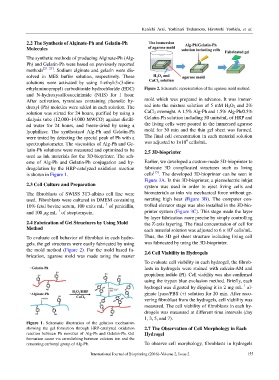
            ethylaminopropyl) carbodiimide hydrochloride (EDC)   Figure 2. Schematic representation of the agarose mold method.
            and  N-hydroxysulfosuccinimide (NHS) for 1  hour.
            After activation,  tyramines containing phenolic hy-  mold which was prepared in advance. It was immer-
            droxyl (Ph) moieties were added in each solution. The   sed into the mixture solution of 5 mM H 2O 2 and 2%
            solution was stirred for 24 hours, purified by using a   CaCl 2 overnight. A 1.5% Alg-Ph and 1.5% Alg-Ph/0.5%
            dialysis tube (12,000–14,000 MWCO) against distill-  Gelatin-Ph solution including 50 units/mL of HRP and
            ed water for 24 hours, and freeze-dried by using a   the living cells were poured in the immersed agarose
            lyophilizer.  The synthesized Alg-Ph  and  Gelatin-Ph   mold for 30 min and the thin gel sheet was formed.
            were tested by detecting the special peak of Ph with a   The final cell concentration in each material solution
                                                                                6
            spectrophotometer. The viscosities of Alg-Ph and Ge-  was adjusted to 1×10  cells/mL.
            latin-Ph solutions were measured and optimized to be   2.5 3D-bioprinter
            used as ink materials for the 3D-bioprinter. The sch-
            eme of  Alg-Ph  and  Gelatin-Ph conjugation  and hy-  Earlier, we developed a custom-made 3D-bioprinter to
            drogelation  by  the  HRP-catalyzed oxidation  reaction   fabricate 3D complicated  structures such  as living
            is shown in Figure 1.                              cells [15] . The developed 3D-bioprinter can be seen in
                                                               Figure 3A. In this 3D-bioprinter, a piezoelectric inkjet
            2.3 Cell Culture and Preparation                   system was used in order  to eject living  cells and

            The fibroblasts of SWISS 3T3-albino  cell line were   biomaterials as inks via mechanical force without ge-
            used. Fibroblasts were cultured in DMEM containing   nerating high  heat (Figure 3B). The computer  con-
                                             −1
            10% fetal bovine serum, 100 units mL  of penicillin,   trolled elevator stage was also installed in the 3D-bio-
                         −1
            and 100 µg mL  of streptomycin.                    printer system (Figure 3C). This stage made the layer
                                                               by layer fabrication more precise by simply controlling
            2.4 Fabrication of Gel Structures by Using Mold    the Z-axis layering. The final concentration of cell for
            Method                                             each material solution was adjusted to 6 × 10  cells/mL.
                                                                                                    6
            To evaluate cell behavior of fibroblast in each hydro-  Thus, the 3D gel sheet structure including living cell
            gels, the gel structures were easily fabricated by using   was fabricated by using the 3D-bioprinter.
            the mold method (Figure 2). For the  mold based fa-  2.6 Cell Viability in Hydrogels
            brication, agarose mold was made using the master
                                                               To evaluate cell viability in each hydrogel, the fibrob-
                                                               lasts in hydrogels were stained with calcein-AM and
                                                               propidium iodide (PI). Cell viability was also confirmed
                                                               using the trypan blue exclusion method. Briefly, each
                                                                                                        −1
                                                               hydrogel was digested by dipping it in 2 mg mL  al-
                                                               ginate lyase/PBS (+) solution for 20 min. After reco-
                                                               vering fibroblast from the hydrogels, cell viability was
                                                               measured. The cell viability of fibroblasts in each hy-
                                                               drogels was measured at different time intervals (day

                                                               1, 3, 5, and 7).
            Figure 1.  Schematic illustration of the gelation mechanism
            showing the gel formation through HRP-catalyzed oxidation   2.7 The Observation of Cell Morphology in Each
            reaction between Ph moieties of Alg-Ph and Gelatin-Ph. Gel   Hydrogel
            formation occur via crosslinking between calcium ion and the
            remaining carboxyl group of Alg-Ph.                To observe cell morphology, fibroblasts in hydrogels

                                        International Journal of Bioprinting (2016)–Volume 2, Issue 2      155

