


Page 96 - IJB-2-2
P. 96
Morphological, mechanical and biological assessment of PCL/pristine graphene scaffolds for bone regeneration

            that at day 3, all scaffolds exhibited similar biological   tion tests of ADSCs were  performed by the supplier

            performance. At day 7, 0.78% PCL/pristine graphene   (ThermoFisher Scientific, UK). The focus of this pa-
            scaffolds exhibited greater fluorescence intensity, sta-  per was to  access the  effect of  low concentration  of
            tistically different form 0%,  corresponding to a high   pristine graphene on both cell viability and prolifera-
            cellular activity. This observation  can indirectly be   tion. Differentiations studies, not reported here,  are
            correlated to higher cell proliferation rate. On the other   being conducted.
            hand, based on the statistical analysis, it is possible to   4. Conclusion
            notice that on day 14, 0.50% and 0.78% PCL/ pristine
            graphene scaffolds positively deviated from PCL sca-  This  paper presents  the  morphological, mechanical,
            ffolds  and  0.13%  PCL/pristine  graphene  scaffolds,   and  biological properties  of PCL/pristine graphene
            showing higher  cell  viability/proliferation  rates.  It is   scaffolds containing different concentrations of  pris-
            also possible to observe that through all the time po-  tine graphene. The results indicate that the screw as-
            ints,  the fluorescence  activity  increased, which indi-  sisted additive  manufacturing system considered in
            cates an increase in the cell proliferation rate. The neg-  this research  work  is a viable technique to produce
            ative control (NC) shows no metabolically active cells.     these composite scaffolds. The results also show that
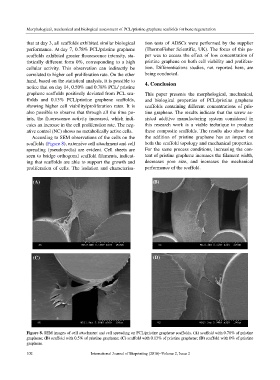
               According to SEM observations of the cells on the   the addition  of pristine graphene  has an  impact on
            scaffolds (Figure 8), extensive cell attachment and cell   both the scaffold topology and mechanical properties.
            spreading (pseudopodia)  are evident.  Cell sheets  are   For the same  process conditions, increasing the con-
            seen to bridge orthogonal scaffold filaments, indicat-  tent of pristine graphene increases the filament width,
            ing that scaffolds are able to support the growth and   decreases  pore size, and increases the  mechanical
            proliferation  of cells.  The isolation  and characterisa-  performance of the scaffold.

               (A)                                                (B)


               (C)                                                (D)


            Figure 8. SEM images of cell attachment and cell spreading on PCL/pristine graphene scaffolds. (A) scaffold with 0.78% of pristine
            graphene; (B) scaffold with 0.5% of pristine graphene; (C) scaffold with 0.13% of pristine graphene; (D) scaffold with 0% of pristine
            graphene.

            102                         International Journal of Bioprinting (2016)–Volume 2, Issue 2

