


Page 95 - IJB-2-2
P. 95
Weiguang Wang, Guilherme Ferreira Caetano, Wei-Hung Chiang, et al.


            Table 3.  Morphological characteristics of scaffold structures   Table 5. Apparent water-in-air contact angle after 20 seconds
            for different pristine graphene concentration       Pristine graphene concentration (% wt)   Contact Angle
               Pristine graphene     Filament width (μm)   Pore size (μm)   0                   96.10 ± 1.51
              concentration (% wt)
                                                                           0.13                 91.78 ± 5.32
                   0                343 ± 5       368 ± 24
                                                                           0.50                 84.68 ± 2.98
                   0.13             361 ± 5       366 ± 11
                                                                           0.78                 88.25 ± 3.95
                   0.50             367 ± 4       347 ± 13
                   0.78             379 ± 14      343 ± 6


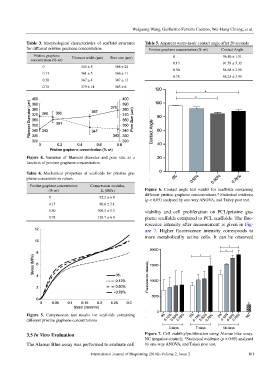
            Figure 4.  Variation of filament diameter and  pore size as  a
            function of pristine graphene concentration.

            Table 4.  Mechanical properties of scaffolds for  pristine gra-
            phene concentration values

              Pristine graphene concentration   Compression modulus,
                      (% wt)                E c [MPa]          Figure 6.  Contact angle  test  results  for  scaffolds containing
                                                               different pristine graphene concentrations.* Statistical evidence
                      0                    82.2 ± 6.8
                                                               (p < 0.05) analysed by one-way ANOVA, and Tukey post test.
                      0.13                 80.6 ± 3.1
                      0.50                 109.3 ± 5.3         viability and cell  proliferation  on  PCL/pristine  gra-
                      0.78                 128.7 ± 6.9         phene scaffolds compared to PCL scaffolds. The fluo-
                                                               rescence intensity after measurement is given in Fig-
                                                               ure  7. Higher  fluorescence intensity corresponds  to
                                                               more  metabolically  active cells.  It  can be observed


            Figure 5.  Compression test results  for  scaffolds containing
            different pristine graphene concentrations.


            3.5 In Vitro Evaluation                            Figure 7. Cell viability/proliferation using Alamar blue assay.
                                                               NC (negative control); *Statistical evidence (p < 0.05) analysed
            The Alamar Blue assay was performed to evaluate cell   by one-way ANOVA, and Tukey post test.
                                        International Journal of Bioprinting (2016)–Volume 2, Issue 2      101

