


Page 93 - IJB-2-2
P. 93
Weiguang Wang, Guilherme Ferreira Caetano, Wei-Hung Chiang, et al.

            (0.001% in culture medium) was added to each well.   the onset of thermal degradation due to the presence
            The plates were incubated for 4 hours under standard   of  pristine  graphene. Results also indicate  that no
            conditions. After incubation, 100 µL of each sample   degradation events occur during the scaffold fabrica-
                                                                                                         o
            was transferred to a 96-well plate and the fluorescence   tion process, since the extrusion temperature was 90 C.
            intensity was  measured  at 540  nm excitation wave-
            length and 590 nm emission wavelength with a spec-  3.2 Morphological Analysis
            trophotometer (Sunrise; Tecan,  Männedorf, Zurich,   Figures 2 and 3 show the SEM micrographs (top and
            Switzerland). Experiments were performed at least   cross-section) of PCL and PCL/pristine graphene sca-
            three times in duplicate.                          ffolds. From the  top view of these  micrographs
                                                               (Figure 2), it is possible to observe that scaffolds pre-
            Cell Morphology                                    sent a well-defined internal geometry and uniform
            After incubation for  14  days, cell-seeded scaffolds   pore distribution. Cross-section micrographs (Figure 3)
            were observed with SEM to assess the cell attachment   show a good adhesion  between adjacent  layers.  The
            and morphology. Scaffold samples were fixed with 2%   values of pore size and filament width are summarised
            glutaraldehyde solution (Sigma-Aldrich, UK)  for 2   in Table 3. Results show an increase in the filament
            hours at room temperature. Then scaffolds were rinsed   width due to the increase in pristine graphene, result-
            twice with PBS, dehydrated with graded ethanol series,   ing in a slight decrease in both pore size and porosity.
            following 50%, 70%, 80%, 90% and 100%, then 50:50   Figure 4 shows the corresponding variation trends.
            ethanol:hexamethyldisilazane (v/v) (HMDS) and 100%
            HMDS (with 10 minutes exposure steps), and then air   3.3 Mechanical Compression Test
            dried for removal of HMDS [35] . Samples were coated   The mechanical behaviour of the scaffolds is strongly
            with platinum and  imaged using SEM, as  described   correlated to the amount of pristine graphene in PCL.
            above.                                             Results show that by increasing the concentration of
                                                               pristine graphene from 0.13% to 0.78%, the compres-
            2.8 Data Analysis                                  sion modulus increased from  80  MPa to  circa  130
            All data were represented as mean ± standard devia-  MPa  (Table 4  and  Figure 5).  This effect is due  not
            tion. Biological  results  were  subjected to one-way   only to  the reinforcement effect of  the  pristine gra-
            analysis of variance (one-way ANOVA) and Tukey’s   phene but also to the differences in terms of pore size
            post-hoc test using GraphPad Prism software. Signifi-  (Table 3).  In comparison to  PCL scaffolds, a slight
            cance levels were set at p < 0.05.                 decrease  in  mechanical properties was observed for
                                                               scaffolds containing  0.13% pristine graphene,  which
            3. Results and Discussion                          the authors  hypothesise,  could be due  to  the stress
                                                               concentration  in the  interface between the  polymer
            3.1 Thermogravimetric Analysis                     and the pristine  graphene, which superpose the rein-

            The final content of pristine graphene in the PCL/pri-  forcement effect  of pristine graphene  and the reduc-
            stine graphene composite scaffolds was calculated by   tion on the pore  size.  Maximum values  of compres-
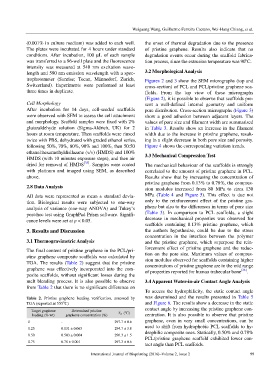
            TGA.  The results (Table 2) suggest  that the pristine   sion modulus observed for scaffolds containing higher
                                                               concentrations of pristine graphene are in the mid range
            graphene  was  effectively  incorporated into the com-  of properties reported for human trabecular bone [36] .
            posite scaffolds, without significant losses during the
            melt blending process. It  is also  possible to observe   3.4 Apparent Water-in-air Contact Angle Analysis
            from Table 2 that there is no significant difference on
                                                               To access the hydrophilicity, the static contact  angle
            Table 2.  Pristine graphene  loading  verification,  assessed  by   was determined and  the results  presented in  Table 5
                            o
            TGA (reported at 555 C)                            and Figure 6. The results show a decrease in the static
                                                               contact angle by increasing the pristine graphene con-
              Target graphene     Determined pristine     o
               loading (% wt)   graphene concentration (%)   T d    ( C)   centration. It is also possible to observe that pristine
             0             -                      297.7 ± 0.6   graphene, even in  very small concentrations, can  be
                                                               used to shift from hydrophobic PCL scaffolds to hy-
             0.25          0.131 ± 0.065          294.7 ± 3.8
             0.50          0.503 ± 0.004          296.3 ± 1.5   drophilic composite ones. Statically, 0.50% and 0.78%
                                                               PCL/pristine graphene scaffold exhibited  lower con-
             0.75          0.78 ± 0.001           297.3 ± 0.6
                                                               tact angle than PCL scaffolds.
                                        International Journal of Bioprinting (2016)–Volume 2, Issue 2      99

