


Page 18 - IJB-2-2
P. 18
3D bioprinting technology for regenerative medicine applications

            this type of printers require bioink of fast gelation ki-  tion and  oxygen. Recently, ITOP (Integrated  Tissue
            netics to develop constructs with good shape fidelity,   Organ Printer) bioprinting method has been reported
            and this may hinder the flow rate during printing [25,58] .   for the fabrication of complex  human tissues with
            Also,  preparing  multiple cells containing ribbon or   good viability and vasculature [69] . This approach dem-
            absorbing layer is a time-consuming process. The con-  onstrated the printing of various polymers and cell ty-
            structs that are fabricated by laser-assisted bioprinting   pes in a single tissue construct using multi-dispensing
            are often found to contain traces of contamination   modules. ITOP uses pneumatic-actuated microextru-
            (comes from the absorbing layer). To avoid such con-  sion method  but  differ in  dispensing systems, hard-
            taminations absorbing layers made up of non-metallic   ware and software as discussed below. ITOP method
            substances are being used [59] . Furthermore, it is hard   uses air pressure to control dispensing volume and a
            to focus the laser spot and to precisely locate the cells   three-axis motorized stage for 3D patterning. The 3D
            during printing. To overcome this difficulty, the “aim   patterns employed  in  ITOP  method  were  generated
            and shoot” technique is used [60] . Here, the laser beam   from computed tomography (CT)  and  magnetic re-
            will scan and choose the region of interest, in order to   sonance imaging (MRI) data of human organs/tissues.
            locate specific cells and to eject  one cell per laser   This data was finally converted into 3D patterns using
            pulse [60] . Using this printing  method bone constructs   a computer-aided design (CAD) software. It was pro-
            and skin with cells for implantation  have  been  suc-  posed that ITOP  method can offer many advantages
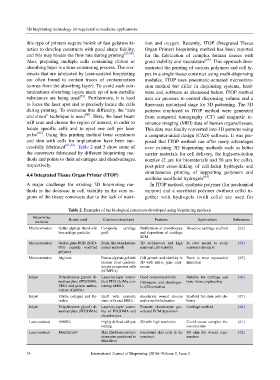
            cessfully fabricated [61,62] . Table 2 and 3 show some of   over existing  3D  bioprinting  methods  such as  better
            the constructs fabricated by different bioprinting me-  carrier materials for cell delivery, the high-resolution
            thods and points to their advantages and disadvantages,   nozzles (2 μm for biomaterials and 50 μm for cells),
            respectively.                                      post-print cross-linking of cell-laden hydrogels and
                                                               simultaneous printing of supporting  polymers and
            4.4 Integrated Tissue Organ Printer (ITOP)
                                                               acellular sacrificial hydrogels [69] .
            A  major challenge for  existing 3D  bioprinting me-  In ITOP method, synthetic polymer (for mechanical
            thods  is  the decrease in cell  viability  in the core  re-  support) and a sacrificial polymer (without cells) to-
            gions of the tissue constructs due to the lack of nutri-  gether with  hydrogels (with cells)  are  used for

                              Table 2. Examples of the biological constructs developed using bioprinting methods
               Bioprinting    Bioink used    Construct developed   Features          Applications   References
                methods
             Microextrusion   Gellan-alginate blend with  Composite  cartilage  Proliferation of chondrocytes  Bioactive cartilage scaffold   [63]
                          biocartilage particles   graft     and deposition of cartilage
                                                             ECM
             Microextrusion   Gellan gum-RGD (RGD-  Brain-like branched ne-  3D architecture  and high  In vitro  model to study   [64]
                          GG)-  peptide  modified  uronal network   neuronal cell viability   neuronal disorders
                          polymer
             Microextrusion   Alginate      Porous alginate gel with  Cell growth and viability in  Patch to treat  myocardial   [65]
                                            Human fetal cardiom-  3D with native gene expr-  infarction
                                            yocyte progenitor cells  ession
                                            (hCMPCs)
             Inkjet       Poly(ethylene glycol)  di-  Layer-by-layer assem-  Good cytocompatibility.   Suitable for cartilage and   [66]
                          methacrylate (PEGDMA,  bled PEG-GelMa con-  Osteogenic and chodrogen-  bone tissue engineering
                          PEG) and gelatin metha-  taining hMSCs   ic differentiation
                          crylate (GelMA)
             Inkjet       Fibrin, collagen and thr-  Graft with amniotic  Accelerate wound closure  Scaffold for stem cells de-  [67]
                          ombin             stem cells and MSCs   and re-epithelialization   livery
             Inkjet       Poly(ethylene glycol) di-  Layer-by-layer assem-  Promote chondrocyte  gro-  Cartilage scaffold   [68]
                          methacrylate (PEGDMA)  bly of PEGDMA and  wth and ECM deposition
                                            chondrocytes
             Laser-assisted   HMSCs         Highly defined cell pat-  3D with high resolution   Could create complex tis-  [61]
                                            terning                             sue structure
             Laser-assisted   Matriderm®     Skin fibroblasts and ker-  Functional skin cells in the  3D skin for wound rege-  [62]
                                            atinocytes positioned in  construct   neration
                                            Matriderm

            14                          International Journal of Bioprinting (2016)–Volume 2, Issue 2

