


Page 16 - IJB-2-2
P. 16
3D bioprinting technology for regenerative medicine applications


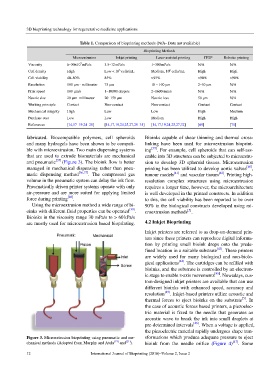
                                   Table 1. Comparison of bioprinting methods (N/A- Data not available)

                                                              Bioprinting Methods

                                Microextrusion    Inkjet printing   Laser-assisted printing   ITOP   Robotic printing


                                   7
             Viscosity        6–30×10 mPa/s   3.5–12 mPa/s       1–300 mPa/s         N/A           N/A
                                                    6
                                                                         8
             Cell density     High           Low < 10  cells/mL   Medium, 10  cells/mL   High      High
             Cell viability   40–80%         85%                 >95%                >90%          >90%
             Resolution       100 μm - millimeter   75 μm        10 – 100 μm         2–50 μm       N/A
             Print speed      100 μm/s       1–10000 drops/s     2–1600 mm/s         N/A           N/A
             Nozzle size      20 μm- millimeter   20–150 μm      Nozzle-less         50 μm         N/A
             Working principle   Contact     Non-contact         Non-contact         Contact       Contact
             Mechanical integrity   High     Low                 Low                 High          Medium
             Purchase cost    Low            Low                 Medium              High          High
             References       [14,17–19,24–28]   [14,17,19,24,25,27,29–31]   [14,17,19,24,25,27,32]   [69]   [70]

            fabricated. Biocompatible  polymers, cell spheroids   Bioinks capable of shear thinning and thermal cross-
            and many hydrogels have been shown to be compati-  linking have been  used  for  microextrusion bioprint-
            ble with microextrusion. Two main dispensing systems   ing [39] . For example, cell spheroids that can self-ass-
            that  are  used  to extrude biomaterials are mechanical   emble into 3D structures can be subjected to microextru-
            and pneumatic [35]  (Figure 3). The bioink flow is better   sion  to  develop 3D spheroid  tissues.  Microextrusion
            managed in mechanical dispensing rather than pneu-  printing has been utilized to develop aortic valves [40] ,
            matic dispensing  method [36,37] . The compressed gas   tumour models [41]  and vascular tissues [42] . Printing high-
            volume in the pneumatic system can delay the ink flow.   resolution complex structures using microextrusion
            Pneumatically driven printer systems operate with only   requires a longer time, however, the microarchitecture
            air-pressure and are more suited for applying limited   is well developed in the printed constructs. In addition
            force during printing [20] .                       to this, the cell viability has been reported to be over
               Using the microextrusion method a wide range of bi-  90% in the biological constructs developed using mi-
            oinks with different fluid properties can be operated [38] .   croextrusion methods .
                                                                                 [5]

            Bioinks in the viscosity range 30 mPa/s to > 60 kPa/s
            are mostly used for microextrusion based bioprinting.     4.2 Inkjet Bioprinting

                                                               Inkjet printers are referred to as drop-on-demand prin-
                                                               ters since these printers can reproduce digital informa-
                                                               tion by printing  small bioink  drops onto the prede-
                                                               fined location in a suitable substrate [43] . These printers
                                                               are widely used for many biological  and non-biolo-
                                                               gical applications [44] . The cartridges can be refilled with
                                                               bioinks, and the substrate is controlled by an electron-
                                                               ic stage to enable z-axis movements [45] . Nowadays, cus-
                                                               tom-designed inkjet printers are available that can use
                                                               different bioinks  with enhanced  speed, accuracy  and
                                                               resolution [45] . Inkjet-based printers utilize acoustic and
                                                                                                        [5]
                                                               thermal forces to eject bioinks on the substrate . In
                                                               the case of acoustic forces based printers, a piezoelec-
                                                               tric material is fixed  to the needle  that  generates an
                                                               acoustic wave to break the ink into small droplets at
                                                               pre-determined intervals [46] . When a voltage is applied,
                                                               the piezoelectric material rapidly undergoes shape tran-

            Figure 3. Microextrusion bioprinting using pneumatic and me-  sformations which produce adequate pressure to eject
            chanical methods (Adopted from Murphy and Atala [19]  and [21] ).   bioink from the needle  orifice (Figure 4) [47] . Some

            12                          International Journal of Bioprinting (2016)–Volume 2, Issue 2

