


Page 15 - IJB-2-2
P. 15
Dhakshinamoorthy Sundaramurthi, Sakandar Rauf and Charlotte A. E. Hauser

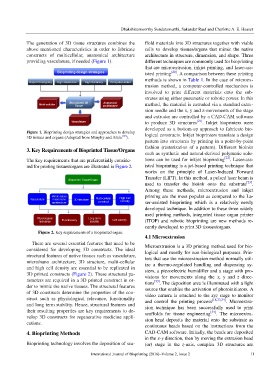
            The generation of 3D tissue structures combines the   ffold materials into 3D structures together with viable
            above mentioned characteristics  in order to fabricate   cells to develop  tissues/organs that  mimic the native
            constructs of  multicellular, anatomical architecture   architecture in structure, dimension, and shape. Three
            providing vasculature, if needed (Figure 1).       different techniques are commonly used for bioprinting
                                                               that are microextrusion, inkjet printing, and laser-ass-
                                                               isted printing [20] . A comparison between these printing
                                                               methods is shown in Table 1. In the case of microex-
                                                               trusion  method, a  computer-controlled mechanism is
                                                               involved  to print different  materials  onto the  sub-
                                                               strates using either pneumatic or robotic power. In this
                                                               method, the material is extruded via a standard extru-
                                                               sion needle and the x, y and z-movements of the stage
                                                               and extruder are controlled by a CAD-CAM software
                                                               to produce 3D  structures [21] . Inkjet  bioprinters were
                                                               developed as a bottom-up approach to fabricate bio-
            Figure 1. Bioprinting design strategies and approaches to develop
            3D tissues and organs (Adopted from Murphy and Atala [19] ).   logical constructs. Inkjet bioprinters translate a design
                                                               pattern into structures by printing in a point-by-point
            3. Key Requirements of Bioprinted Tissue/Organs    fashion (rasterization of  a  pattern). Different bioinks
                                                               such as synthetic and natural-derived polymeric solu-
            The key requirements that are preferentially conside-  tions can be used for inkjet bioprinting [22] . Laser-ass-
            red for printing tissues/organs are illustrated in Figure 2.   isted bioprinting is a jet-based printing technique that
                                                               works on the principle  of Laser-Induced Forward
                                                               Transfer (LIFT). In this method, a pulsed laser beam is
                                                               used to transfer the bioink  onto the substrate [23] .
                                                               Among these  methods, microextrusion and  inkjet
                                                               printing are the most popular as compared to the La-
                                                               ser-assisted bioprinting which is a relatively newly
                                                               developed technique. In addition to these three widely
                                                               used printing methods, integrated tissue organ printer
                                                               (ITOP) and robotic bioprinting are  new methods re-

                                                               cently developed to print 3D tissues/organs.
                 Figure 2. Key requirements of a bioprinted organ.
                                                               4.1 Microextrusion
               There are several essential features that need to be   Microextrusion is a 3D printing method used for bio-
            considered for developing  3D constructs. The ideal   logical and mostly for non-biological purposes. Prin-
            structural features of native tissues such as vasculature,   ters that use the microextrusion method normally util-
            micro/nano  architecture, 3D structure,  multi-cellular   ize  a thermo-regulated handling and dispensing sy-
            and high cell density are essential to be replicated in   stem, a piezoelectric humidifier and a stage with pro-
            3D printed constructs (Figure 2). These structural pa-  visions for  movements along the  x,  y  and  z  direc-
            rameters are required in a 3D printed construct in or-  tions [33] . The deposition area is illuminated with a light
            der to mimic the native tissues. The structural features   source that enables the activation of photoinitiators. A
            of 3D constructs determine the properties of the con-  video camera is attached to the xyz stage to monitor
            struct such  as physiological relevance,  functionality   and control the  printing process [18,33,34] . Microextru-
            and long term stability. Hence, structural features and   sion  technique has  been successfully  used  to  print
            their resulting properties are key requirements to de-  scaffolds for tissue engineering [34] . The  microextru-
            velop 3D constructs for regenerative medicine appli-  sion  head deposits  the  material onto  the substrate as
            cations.
                                                               continuous  beads  based  on the instructions from the
            4. Bioprinting Methods                             CAD-CAM software. Initially, the beads are deposited
                                                               in the x-y direction, then by moving the extrusion head
            Bioprinting technology involves the deposition of sca-  (or) stage in  the  z-axis, complex 3D structures  are

                                        International Journal of Bioprinting (2016)–Volume 2, Issue 2       11

