


Page 23 - IJB-2-2
P. 23
Dhakshinamoorthy Sundaramurthi, Sakandar Rauf and Charlotte A. E. Hauser

            meters that need to be considered to develop 3D con-  ulus of  >500  mPa and used to print bone constru-
            structs for regenerative medicine applications. Some   cts [104] . In another study, Cooper et al. [105]  have devel-
            of the applications of 3D bioprinting in regenerative   oped a 3D printed bone made from DermaMatix and
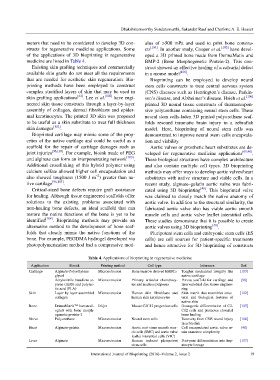
            medicine are listed in Table 4.                    BMP-2 (Bone Morphogenetic Protein-2).  This con-
               Existing skin grafting techniques and commercially   struct showed an effective healing of a calvarial defect
            available skin grafts do not meet all the requirements   in a mouse model [105] .
            that are  needed for  aesthetic skin regeneration. Bio-  Bioprinting  can be employed to  develop  neural
            printing methods have been employed to construct   stem cells constructs to  treat central  nervous system
            complex stratified layers of skin that may be used in   (CNS) diseases such as Huntington’s disease, Parkin-
            skin grafting applications [62] . Lee et al. [102]  have engi-  son’s disease, and Alzheimer’s disease. Hsieh et al. [106]
            neered skin tissue constructs through a layer-by-layer   printed 3D neural tissue constructs of thermorespon-
            assembly  of  collagen, dermal  fibroblasts and epider-  sive polyurethane containing neural stem cells. These
            mal keratinocytes. The printed 3D skin was proposed   neural stem cells-laden 3D printed polyurethane scaf-
            to be useful as a skin substitute to treat full thickness   folds rescued traumatic  brain injury in a  zebrafish
            skin damages [102] .                               model.  Here,  bioprinting  of neural  stem cells was
               Bioprinted cartilage may mimic some of the prop-  demonstrated to improve neural stem cells encapsula-
            erties of the native cartilage and could be useful as a   tion and viability.
            scaffold for the repair of cartilage damages such as   Aortic valves or prosthetic heart substitutes are de-
            joint injuries [96,103] . For example, bioink made of PEG   veloped  for  regenerative medicine applications [65,40] .
            and alginate can form an interpenetrating network [103] .   These biological structures have complex architecture
            Additional crosslinking of this hybrid polymer using   and also contain multiple  cell types.  3D bioprinting
            calcium sulfate allowed higher cell encapsulation and   methods may offer ways to develop aortic valves/heart
                                          –2
            also showed toughness (1500 J m ) greater than na-  substitutes with native structure and viable cells. In a
            tive cartilage [96,103] .                          recent study,  alginate–gelatin aortic  valve was fabri-
               Critical-sized bone defects require graft assistance   cated using  3D bioprinting [40] . This bioprinted  valve
            for healing. Although tissue engineered scaffolds offer   was claimed to closely match the native anatomy of
            solutions to  the  existing problems  associated  with   aortic valve. In addition to the structural similarity, the
            non-healing bone defects, an  ideal  scaffold that  can   fabricated  aortic valve also has viable aortic  smooth
            restore the  native functions of the bone  is yet to be   muscle cells and aortic valve leaflet interstitial cells.
            identified [104] . Bioprinting  methods may provide an   These studies demonstrate that it is possible to create
            alternative method to  the  development  of bone scaf-  aortic valves using 3D bioprinting [40] .
            folds that closely  mimic the native functions  of the   Pluripotent stem cells and embryonic stem cells (ES
            bone. For example, PEGDMA hydrogel developed via   cells)  are cell sources for  patient-specific treatments
            photopolymerization method had a compressive mod-  and hence attractive for 3D bioprinting of constructs

                                      Table 4. Applications of bioprinting in regenerative medicine
              Application      Bioink       Printing method     Cell type             Inference        Ref.
             Cartilage   Alginate-Polyethylene   Microextrusion   Bone marrow derived hMSCs   Tougher  mechanical integrity like   [103]
                        glycol                                                native cartilage
                        Acrylonitrile butadiene st-  Microextrusion   Primary  articular chondrocy-  Porous  scaffold  for  cartilage  and   [96]
                        yrene (ABS) and polylac-         tes and nucleus pulposus     intervertebral disc tissue enginee-
                        tic acid (PLA)                                        ring
             Skin       Layer-by-layer assembled  Microextrusion   Human skin fibroblasts and  Skin matrix that resembles struc-  [102]
                        collagen                         human skin keratinocytes   tural and biological features of
                                                                              native skin
             Bone       DermaMatrix™ human all-  Inkjet     Mouse C2C12 progenitor cells  Osteogenic differentiation of C2-  [105]
                        ograft with bone morph-                               C12 cells and promotes clavarial
                        ogenetic protein-2                                    bone healing
             Nerve      Polyurethane       Microextrusion   Neural stem cells   Recovery from CNS neural injury   [106]
                                                                              in zebra fish
             Heart      Alginate-gelatin   Microextrusion   Aortic root sinus smooth mus-  Cell encapsulated aortic valve re-  [40]
                                                         cle cells (SMC) and aortic valve  tain anatomic complexity
                                                         leaflet interstitial cells (VIC)
             Liver      Alginate           Microextrusion   Human induced pluripotent  Post-print differentiation into hep-  [107]
                                                         stem cells           atocyte lineage
                                        International Journal of Bioprinting (2016)–Volume 2, Issue 2      19

