


Page 67 - IJB-2-2
P. 67
Atra Malayeri, Colin Sherborne, Thomas Paterson, et al.


            approach, the inherent porosity dictated by the emul-  tissue engineering constructs. A human osteosarcoma
            sion templating is retained, while the larger pore sizes   cell line (MG63) was cultured on bulk and woodpile
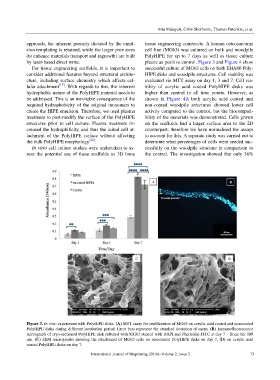
            (to enhance materials transport and ingrowth) are built   PolyHIPE for up  to  7 days as well  as tissue culture
            by laser-based direct write.                       plastic as positive control. Figure 3 and Figure 4 show
               For tissue engineering scaffolds, it is important to   successful culture of MG63 cells on both EHA80 Poly-
            consider additional features beyond structural archite-  HIPE disks and woodpile structures. Cell viability was
            cture, including surface  chemistry which affects cel-  evaluated via MTT assay on day 1, 3 and 7. Cell via-
            lular attachment [15] . With regards to this, the inherent   bility of acrylic acid coated PolyHIPE disks was
            hydrophobic nature of the PolyHIPE material needs to   higher than control in  all time  points. However, as
            be addressed. This is an inevitable consequence of the   shown in  Figure  4A  both acrylic  acid coated and
            required hydrophobicity of the original monomers to   non-coated woodpile structures showed lower cell
            create the HIPE emulsion. Therefore, we used plasma   activity compared to the control, but the biocompati-
            treatment to post-modify the surface of the PolyHIPE   bility of the materials was demonstrated. Cells grown
            structures prior to cell  culture. Plasma treatment in-  on the  scaffolds  had a larger  surface area to the 2D
            creased the hydrophilicity, and thus the initial cell at-  counterpart; therefore we have normalised the assays
            tachment  of  the PolyHIPE surface without affecting   to account for this. A separate study was carried out to
            the bulk PolyHIPE morphology [22] .                determine what percentages of cells were seeded suc-
               In vitro cell culture studies were undertaken to as-  cessfully on the woodpile structure in comparison to
            sess the potential  use  of these scaffolds as 3D  bone   the control. The investigation showed that only 36%


            Figure 3. In vitro experiment with PolyHIPE disks. (A) MTT assay for proliferation of MG63 on acrylic acid coated and non-coated
            PolyHIPE disks during different incubation period. Error bars represent the standard deviation of mean. (B) Immunofluorescence
            micrograph of cryo-sectioned PolyHIPE disk cultured with MG63 stained with DAPI and Phalloidin-FITC at day 7 – Scale bar 100
            μm. (C) SEM micrographs showing the attachment of MG63 cells on non-coated PolyHIPE disks on day 7, (D) on acrylic acid
            coated PolyHIPE disks on day 7.
                                        International Journal of Bioprinting (2016)–Volume 2, Issue 2      73

