


Page 66 - IJB-2-2
P. 66
Osteosarcoma growth on trabecular bone mimicking structures manufactured via laser direct write


            pores, a statistical correction factor was used to create   the macroporosity of the trabecular bone. The trabecu-
                                                        [3]
            a more accurate estimate of the actual pore diameter .   lar bone exhibits a macroporosity of 300–600 µm and
            The average  pore  diameter for EHA80 PolyHIPE is   a porosity of 75–85% [28] . The produced scaffolds have
            33.3 μm (mean standard deviation ± 10.6 μm).       a strut size of 250 µm and a fibre spacing of 1100 µm,
               The woodpile structures  presented similar beha-  while exhibiting a macroporosity of 82% and a pore size
            viour. Increasing the IBOA content increases the sti-  of 425 µm (given that the layers are offset by 550 µm).
            ffness  of  the material and reduces the  swelling.  For   These scaffolds have a much higher macroscopic po-
            scaffolds with high EHA content, the PolyHIPE can   rosity and a larger macroscopic pore size compared to
            be freeze dried to prevent the PolyHIPE from shrink-  the structures reported in  our previous  study  (58%
            ing as it dries [10] .                             macroporosity and 150 µm pores) [24] .  Young’s mod-
               Woodpile layered structures  from a high internal   ulus of the 80% porous material is 1.22 MPa [24] .
            phase  emulsion are fabricated successively  to create
            selectively cured regions of PolyHIPE in a stereoli-  3.2 Osteosarcoma Growth
            thography-based direct laser  writing approach.  This   In this study, we assessed the growth of human osteo-
            was achieved by selectively curing the top layer of a   sarcoma (MG-63) on these 3D printed scaffolds. Our
            well of the HIPE emulsion, and subsequently adding   PolyHIPE structure is based on a mixture of the elas-
            layers of the emulsion and curing them to build up an   tomer  component  EHA  and  the  brittle component
            object  in a layer-by-layer  manner (Figure  2).  This   IBOA (at a 66–33% w/w ratio). These PolyHIPEs are
            leads the way for more complex structures to be made.   typically produced as monoliths with the pore size
            However, increasing the size or number of layers will   solely determined by the emulsion templating process.
            increase  the  build time per scaffold. The total build   These pore sizes are typically of the order of 10–50 µm,
            time per scaffold was less than 10 minutes and the   which can impede cell ingrowth and materials transfer.
            scaffold parameters were nearly identical by  visual   To mitigate for this, previous studies used a high water
            inspection. The final structures were demonstrated to   volume of 90% and an elevated temperature to desta-
                                                                                                    [1]
            be suitable for 3D cell culture applications and mimic   bilise the emulsion  for  larger  pore sizes .  In our


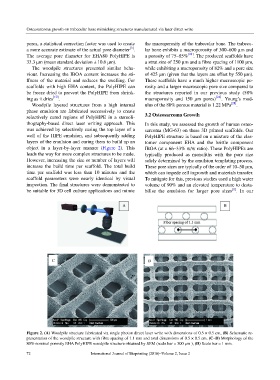
            Figure 2. (A) Woodpile structure fabricated via single photon direct laser write with dimensions of 0.5 × 0.5 cm, (B) Schematic re-
            presentation of the woodpile structure with fibre spacing of 1.1 mm and total dimensions of 0.5 × 0.5 cm. (C–D) Morphology of the
            80% nominal porosity EHA PolyHIPE woodpile structure obtained by SEM (scale bar = 500 μm ), (D) Scale bar = 1 mm.

            72                          International Journal of Bioprinting (2016)–Volume 2, Issue 2

