


Page 65 - IJB-2-2
P. 65
Atra Malayeri, Colin Sherborne, Thomas Paterson, et al.

            Phalloidin was excited using a 488 nm laser (4% tran-  example a closed surface is observed when the HIPE
                                                                                           [2]
            smission) and emission detected above 505 nm. For   is  cured against polypropylene .  Similar features
            differential interference contrast (DIC), a 543 nm laser   were observed in the HIPE emulsion when selectively
            (21.8% transmission) was used without filters to pro-  curing regions within the  bulk emulsion. The boun-
            duce a contrast of scaffold. Z-stacks were converted to   dary between the cured and uncured HIPE formed a
            single images using ImageJ’s Z-project feature using   surface skin during the post-processing stages to wash
            the max intensity blend setting. Images were measured   and dry the PolyHIPE structures. This is attributed to a
            and scale bars were also added by ImageJ.          structural collapse of a partially cured boundary layer
                                                               on the surface of the PolyHIPE. There are two plausi-
            3. Results and Discussion                          ble explanations for  this  phenomenon: (i) the HIPE
            3.1 Morphological Characterisation                 material acted as a scattering medium for the curing
                                                               UV light, and (ii) the diffusion of reactive radicals
            The morphology and surface structure of the woodpile   from the photo-initiated region.
            structures were analysed using SEM. Typical Poly-    The microporosity can be controlled by the speed
            HIPE morphology was maintained within the scaffolds,   of the paddle stirrer. The  pore size  of the  polyHIPE
            suggesting the selective polymerisation  of the Poly-  produced at a stir speed of 350 rpm was determined
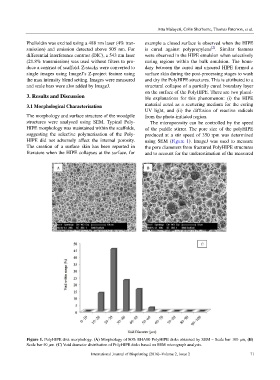
            HIPE did  not adversely affect  the  internal porosity.   using SEM (Figure  1). ImageJ was used to  measure
            The  creation of  a  surface skin has been  reported in   the pore diameters from fractured PolyHIPE structures
            literature when the HIPE collapses at the surface, for   and to account for the underestimation of the measured


            Figure 1. PolyHIPE disk morphology. (A) Morphology of 80% EHA80 PolyHIPE disks obtained by SEM – Scale bar 100 μm, (B)
            Scale bar 50 μm. (C) Void diameter distribution of PolyHIPE disks based on SEM micrograph analysis.
                                        International Journal of Bioprinting (2016)–Volume 2, Issue 2      71

