


Page 487 - IJB-10-2
P. 487
International Journal of Bioprinting                                Bioprinted skin for testing of therapeutics


            to create a high-throughput bioprinting platform. The   the bioink. The magnet within the reservoir was rotated
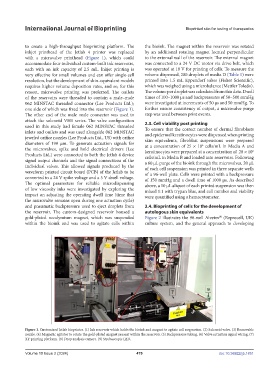
            inkjet printhead of the Jetlab 4 printer was replaced   by  an  additional  rotating  magnet  located perpendicular
            with a microvalve printhead (Figure 1), which could   to the external wall of the reservoir. The external magnet
            accommodate four individual custom-built ink reservoirs,   was connected to a 24 V DC motor via drive belt, which
            each  with  an  ink  capacity  of  2.5  mL.  Inkjet  printing  is   was operated at 18 V for printing of cells. To measure the
            very effective for small volumes and can offer single-cell   volume dispensed, 200 droplets of media D (Table 1) were
            resolution, but the development of skin-equivalent models   printed into 1.5 mL Eppendorf tubes (Fisher Scientific),
            requires higher volume deposition rates, and so, for this   which was weighed using a microbalance (Mettler Toledo).
            reason, microvalve printing was preferred. The outlets   The volume per droplet was calculated from this data. Dwell
            of the reservoirs were threaded to contain a male–male   times of 100–1000 µs and backpressures of 50–500 mmHg
            062 MINSTAC threaded connector (Lee Products Ltd.);   were investigated at increments of 50 µs and 50 mmHg. To
            one side of which was fixed into the reservoir (Figure 1).   further ensure consistency of output, a microvalve purge
            The  other  end  of  the  male–male  connector  was  used  to   step was used between print events.
            attach the solenoid VHS  series. The valve configuration
            used in this study had female 062 MINSTAC threaded   2.3. Cell viability post printing
                                                               To ensure that the correct number of dermal fibroblasts
            inlets and outlets and was used alongside 062 MINSTAC   and epidermal keratinocytes were dispensed when printing
            jeweled orifice nozzles (Lee Products Ltd., US) with orifice   skin equivalents, fibroblast suspensions were prepared
            diameters of 190 µm. To generate actuation signals for   at a concentration of 25 × 10  cells/mL in Media A and
                                                                                       6
            the microvalves, spike and hold electrical drivers (Lee   keratinocytes were prepared at a concentration of  20 × 10
                                                                                                             6
            Products Ltd.) were connected to both the Jetlab 4 device   cells/mL in Media B and loaded into reservoirs. Following
            signal output channels and the signal connections of the   a 60 µL purge of the bioink through the microvalves, 20 µL
            Individual valves. This allowed signals produced by the   of each cell suspension was printed in three separate wells
            waveform printed circuit board (PCB) of the Jetlab to be   of a 96-well plate. Cells were printed with a backpressure
            converted to a 24 V spike voltage and a 5 V dwell voltage.   of 150 mmHg and a dwell time of 1000 µs. As described
            The  optimal  parameters  for  reliable  microdispensing   above, a 10 µL aliquot of each printed suspension was then
            of low viscosity inks were investigated by exploring the   mixed 1:1 with trypan blue, and cell number and viability
            impact on adjusting the operating dwell time (time that   were quantified using a hemocytometer.
            the microvalve remains open during one actuation cycle)
            and pneumatic backpressure used to eject droplets from   2.4. Bioprinting of cells for the development of
            the reservoir. The custom-designed reservoir housed a   autologous skin equivalents
                                                                                               ®
            gold-plated  neodymium  magnet,  which  was  suspended   Figure 2 illustrates the 96-well Alvetex  (Reprocell, UK)
            within  the  bioink  and  was  used  to  agitate  cells  within   culture system, and the general approach to developing


            Figure 1. Customized Jetlab bioprinter. (1) Ink reservoir which holds the bioink and magnet to agitate cell suspension. (2) Solenoid valve. (3) Removable
            nozzle. (4) Magnetic agitator to rotate the gold-plated magnet present within the reservoir. (5) Backpressure tubing. (6) Valve actuation signal wiring. (7)
            XY printing platform. (8) Drop analysis camera. (9) Stroboscopic LED.


            Volume 10 Issue 2 (2024)                       479                                doi: 10.36922/ijb.1851

