


Page 491 - IJB-10-2
P. 491
International Journal of Bioprinting                                Bioprinted skin for testing of therapeutics


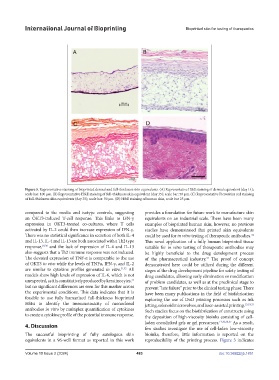
            Figure 5. Representative staining of bioprinted dermal and full-thickness skin equivalents. (A) Representative H&E staining of dermal equivalent (day 14);
            scale bar: 100 µm. (B) Representative H&E staining of full-thickness skin equivalent (day 35); scale bar: 50 µm. (C) Representative Picrosirius red staining
            of full-thickness skin equivalents (day 35); scale bar: 50 µm. (D) H&E staining of human skin, scale bar 25 µm.


            compared  to  the  media  and  isotype  controls,  suggesting   provides a foundation for future work to manufacture skin
            an OKT3-induced T-cell response. This links to IFN-γ   equivalents on an industrial scale. There have been many
            expression in OKT3-treated co-cultures, where T cells   examples of bioprinted human skin; however, no previous
            activated by IL-2 could then increase expression of IFN-γ.   studies have demonstrated that printed skin equivalents
            There was no statistical significance in secretion of both IL-4   could be used for in vitro testing of therapeutic antibodies.
                                                                                                            34
            and IL-13. IL-4 and IL-13 are both associated with a Th2 type   This novel application of a fully human bioprinted tissue
            response, 29,30  and the lack of expression of IL-4 and IL-13   suitable for  in vitro testing of therapeutic antibodies may
            also suggests that a Th2 immune response was not induced.   be highly beneficial to the drug development process
            The elevated expression of TNF-α is comparable to the use   of the pharmaceutical industry.  The proof of concept
                                                                                         34
            of OKT3 in vivo while the levels of TNFα, IFN-γ, and IL-2   demonstrated here could be utilized during the different
            are similar to cytokine profiles generated  in vitro. 31,32  All   stages of the drug development pipeline for safety testing of
            models show high levels of expression of IL-6, which is not   drug candidates, allowing early elimination or modification
            unexpected, as it is constitutively produced by keratinocytes,    of problem candidates, as well as at the preclinical stage to
                                                         33
            but no significant differences are seen for this marker across   prevent “late failure” prior to the clinical testing phase. There
            the experimental conditions. This data indicates that it is   have been many publications in the field of biofabrication
            feasible to use fully humanized full-thickness bioprinted   exploring the use of DoD  printing processes  such as ink
            HSEs to identify the immunotoxicity of monoclonal   jetting, solenoid microvalves, and laser-assisted printing. 13,19,35
            antibodies in vitro by multiplex quantification of cytokines   Such studies focus on the biofabrication of constructs using
            to create a cytokine profile of the potential immune response.  the deposition of high-viscosity bioinks consisting of cell-
                                                               laden crosslinked gels or gel precursors. 14,20,36,37  As a result,
            4. Discussion                                      few studies investigate the use of cell-laden low-viscosity
            The successful bioprinting of fully autologous skin   bioinks; therefore, little information is reported on the
            equivalents in a 96-well  format as  reported in this work   reproducibility of the printing process.  Figure 3 indicates

            Volume 10 Issue 2 (2024)                       483                                doi: 10.36922/ijb.1851

