


Page 490 - IJB-10-2
P. 490
International Journal of Bioprinting                                Bioprinted skin for testing of therapeutics


            successfully deposit material, and attempting to print with   dermis of the full-thickness human skin equivalent (HSE)
            parameters below these values did not yield successful   was well populated with a layer of fibroblasts on top of the
            droplet deposition. At lower dwell times (Figure 3A–D),   scaffold supporting the epidermis. The epidermis of the
            a variance in the volume per droplet was demonstrated   HSE contained visible basal, spinous, and granular layers
            across the range of backpressures tested. Higher dwell   and a very thin stratum corneum. The differentiating and
            times (Figure 3E–I) resulted in a more linear increase   superficially migrating keratinocytes formed a spinous
            in the volume per droplet dispensed across the pressure   layer. The layer of granular cells indicated by the darker
            range. Peak output was 210 ± 6 nL per droplet, produced at   and slightly speckled hematoxylin-stained nuclei (which
            a dwell time of 1000 μs with a backpressure of 500 mmHg.   separated during sectioning) was located above the spinous
            A dwell time of 1000 μs and a backpressure of 150 mmHg   keratinocytes. Picrosirius red staining of bioprinted full-
            with a volume per droplet of 103 ± 1 nL were used to print   thickness skin equivalents showed that the dermis was
            cells  and  produce  skin  equivalents,  giving  good  balance   heavily  loaded  with  collagen  (Figure  5C).  Large  thick
            between productivity and consistency of output.    crosslinked collagen layers could be seen directly beneath
               To print the skin-equivalent models, fibroblasts   the epidermis at the dermal–epidermal junction. This layer
            were suspended at 25 × 10 cells/mL and keratinocytes   of collagen could be seen across the dermis, supporting the
                                   6
            were suspended at 20 × 10 cells/mL with 20 µL of each   formation of an epidermis.
                                  6
            suspension per well into 3 wells. The cell counts and viability   Immunofluorescence staining was used to stain
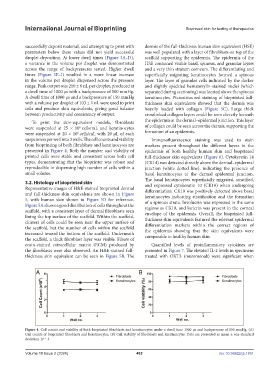
            from bioprinting of both fibroblasts and keratinocytes are   markers  present  throughout  the  different  layers  in  the
            presented in Figure 4. Both the number and viability of   epidermis of both healthy human skin and bioprinted
            printed cells  were stable  and  consistent across both  cell   full-thickness skin equivalents (Figure 6). Cytokeratin 14
            types, demonstrating that the bioprinter was robust and   (CK14) was detected directly above the dermal–epidermal
            reproducible in dispensing high number of cells within a   junction (white dotted line), indicating the presence of
            small volume.                                      basal keratinocytes at the dermal epidermal junction.
                                                               The  basal  keratinocytes  superficially  migrated,  stratified,
            3.2. Histology of bioprinted skin                  and expressed cytokeratin 10 (CK10) when undergoing
            Representative images of H&E-stained bioprinted dermal   differentiation. CK10 was positively detected above basal
            and  full-thickness  skin  equivalents  are  shown  in  Figure   keratinocytes indicating stratification and the formation
            5, with human skin shown in  Figure 5D for reference.    of a spinous strata. Involucrin was expressed in the same
            Figure 5A shows a good distribution of cells throughout the   regions as CK10, and loricrin was present in the corneal
            scaffold, with a consistent layer of dermal fibroblasts seen
            lining the top surface of the scaffold. Within the scaffold,   envelope of the epidermis. Overall, the bioprinted full-
            clusters of cells could be seen near the upper surface of   thickness skin equivalents featured the relevant epidermal
            the scaffold, but the number of cells within the scaffold   differentiation markers within the correct regions of
                                                               the epidermis showing that the skin equivalents were
            increased toward the bottom of the scaffold. Underneath   comparable to healthy human skin.
            the scaffold, a thick fibroblast layer was visible. Fibers of
            eosin-stained extracellular matrix (ECM) produced by   Quantified levels of proinflammatory cytokines are
            the fibroblasts were also observed. An H&E-stained full-  presented in Figure 7. The elevated IL-2 levels in specimens
            thickness skin equivalent can be seen in  Figure 5B. The   treated with OKT3 (muromonab) were significant when


            Figure 4. Cell counts and viability of both bioprinted fibroblasts and keratinocytes under a dwell time 1000 μs and backpressure of 150 mmHg. (A)
            Cell counts of bioprinted fibroblasts and keratinocytes. (B) Cell viability of fibroblasts and keratinocytes. Data are presented as mean ± one standard
            deviation. N = 3.


            Volume 10 Issue 2 (2024)                       482                                doi: 10.36922/ijb.1851

