


Page 544 - IJB-10-2
P. 544
International Journal of Bioprinting                          Bottom-up and top-down VAT photopolimerization


            The  dual-mode  DLP  system  presented  in  this  study   projected to fabricate the first layer. For the succeeding
            was used for the fabrication of various complex    layer, the velocity of stage was increased to move the stage
            constructs in order to showcase its potential as a novel    in the upward direction, and the new layer was polymerized
            biofabrication method.                             by a dynamic photomask. The supply of pre-polymer
                                                               solution was maintained by injecting the polymer into the
            3.1. Complex scaffold printing                     chamber through a microfluidic chip setup. Fabrication
            In the proposed bottom-up biofabrication strategy for hard   parameters including the depth of pre-polymer stream,
            tissue bioprinting (Figure 1a(i)), the desired pattern was   curing depth, curing uniformity, and spatial resolution in
            created by reflecting UV illumination from the DMD array   X, Y, and Z directions were previously optimized for PCT
            focused on the specific focal plane to crosslink the pre-  using a range of UV exposure times and intensities using
            polymer solutions. The light beam was projected from the   a stereolithography system . To demonstrate the bottom-
                                                                                    [33]
            bottom of the platform to the polymer solution. As the UV   up bioprinting approach capability, we engineered 3D
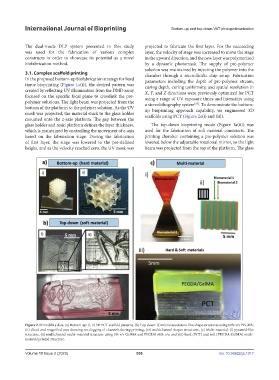
            mask was projected, the material stuck to the glass holder   scaffolds using PCT (Figure 2a(i) and (ii)).
            mounted onto the z-axis platform. The gap between the
            glass holder and resin platform defines the layer thickness,   The top-down bioprinting mode (Figure 1a(ii)) was
            which is maintained by controlling the movement of z-axis   used for the fabrication of soft material constructs. The
            based on the fabrication stage. During the fabrication   printing chamber containing a pre-polymer solution was
            of first layer, the stage was lowered to the pre-defined   lowered below the adjustable rotational mirror, so the light
            height, and as the velocity reached zero, the UV mask was   beam was projected from the top of the platform. The glass


            Figure 2. Printability data. (a) Bottom-up: (i, ii) 3D PCT scaffold patterns. (b) Top-down: (i) microvasculature-like shape structures using 60% v/v PEGDA,
            (ii) sliced and magnified area showing no clogging of channels during printing, (iii) multichannel shapes structures, (c) Multi-material: (i) pyramid-like
            structure, (ii) multichannel multi-material structure using 5% v/v GelMA and PEGDA 60% v/v, and (iii) hard (PCT) and soft (PEGDA-GelMA) multi-
            material printed structure.


            Volume 10 Issue 2 (2023)                       536                                doi: 10.36922/ijb.1017

