


Page 546 - IJB-10-2
P. 546
International Journal of Bioprinting                          Bottom-up and top-down VAT photopolimerization


            kPa)  can be imitated by tuning the bioink composition   compared to control until day 7 after bioprinting (n = 3).
               [48]
            and crosslinking parameters.                       However, on day 7, cells grown in monolayer showed a
                                                               higher growth rate (n = 3). The viability of encapsulated
            3.4. Cell viability and proliferation              cells was observed until day 7 in hydrogel post-printing and
            The initial results highlight the potential of this   quantified. The cell viability in case of both HUVECs and
            new bioprinting approach to create multi-material   C2C12 until day 7 was more than 89% with no significant
            heterogeneous architectures for tissue engineering   difference. A slight difference at days 3 and 7 was observed
            applications. In addition, the bioprinter can regulate the   when compared to gel-free control (n = 3).
            structure’s stiffness by controlling printing parameters,
            such  as  hydrogel concentration,  PI  concentration,  and   3.5. Multi-material musculoskeletal model
            light exposure time. As a proof of concept, cell viability   Using the microfluidics configuration described in section 2
            and proliferation rate in 5% w/v GelMA was assessed.   (Figure 1d),  we developed a  multi-material  bioprinting
            Two GelMA-based bioinks, containing HUVECs and     approach for generating a musculoskeletal tissue model with
            C2C12 cells, respectively, were used, and viability and   integrated vasculature. We combined two different cell types,
            proliferation assays were analyzed (Figure 3b–e). The   i.e., HUVECs and MSCs, for the vasculature, and used C2C12
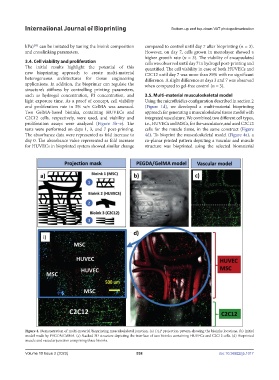
            tests were performed on days 1, 3, and 7 post-printing.   cells for the muscle tissue, in the same  construct (Figure
            The absorbance data were represented as fold increase to   4d). To bioprint the musculoskeletal model (Figure 4a), a
            day 0. The absorbance value represented as fold increase   co-planar printed pattern depicting a vascular and muscle
            for HUVECs in bioprinted system showed similar change   structure was bioprinted using the selected biomaterial


            Figure 4. Demonstration of multi-material bioprinting musculoskeletal junction. (a) DLP projection pattern showing the bioinks locations. (b) Initial
            model made by PEGDA/GelMA. (c) Stacked 3D structure depicting the interface of two bioinks containing HUVECs and C2C12 cells. (d) Bioprinted
            muscle and vascular junction comprising three bioinks.

            Volume 10 Issue 2 (2023)                       538                                doi: 10.36922/ijb.1017

