


Page 36 - IJB-3-1
P. 36
Recent cell printing systems for tissue engineering


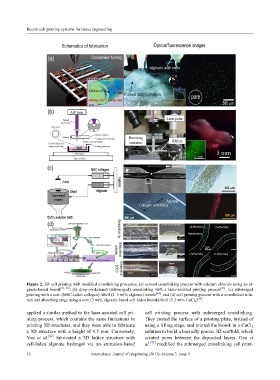
            Figure 2. 3D cell printing with modified crosslinking processes, (a) aerosol crosslinking process with calcium chloride using an al-
            ginate-based  bioink [36–38] ,  (b)  drop-on-demand  (submerged)  crosslinking  with  a  laser-assisted  printing  process [41] ,  (c)  submerged
            printing with a core (MSC-laden collagen) /shell (2–5 wt% alginate) nozzle [44] , and (d) cell printing process with a crosslinked solu-
            tion and absorbing stage using a core (3 wt% alginate-based cell-laden bioink)/shell (1.2 wt% CaCl 2 ) [46] .

            applied a similar method to the laser-assisted cell pri-  cell  printing  process  with  submerged  crosslinking.
            nting process, which contains the same limitations in   They coated the surface of a printing plate, instead of
            printing 3D structures, and they were able to fabricate   using a lifting stage, and printed the bioink in a CaCl 2
            a 3D structure with a height of 9.5 mm. Conversely,   solution to build a biaxially porous 3D scaffold, which
            You  et  al. [42]   fabricated  a  3D  lattice  structure  with   created  pores  between  the  deposited  layers.  Gao  et
            cell-laden  alginate  hydrogel  via  an  extrusion-based   al. [43]  modified the submerged crosslinking cell print-

            32                          International Journal of Bioprinting (2017)–Volume 3, Issue 1

