


Page 57 - IJB-10-3
P. 57
International Journal of Bioprinting                      3D-printed biodegradable metals for bone regeneration


            of combining the good biocompatibility and plasticity of   degradation, eliminating the need for secondary surgical
            nonmetallic  materials  with  the  bioactivity  of  BMs. 185-187    removal. 124,193-195   The bone-enhancing properties of
            These scaffolds are usually prepared by fused deposition   magnesium ions can also lead to a significant increase in
            modeling, in which metal powders are mixed with PEEK,   the healing rate of osteoporotic fractures.  In recent years,
                                                                                               196
            PCL, etc. to form fused filaments, which are heated and   successful treatment of fractures using BM materials has
            extruded through a nozzle during printing and stacked   been achieved in the clinic, and good therapeutic results
            layer by layer to generate the finished product. 133,186,188    have been obtained. 197-201
            Depending on the material used, cryogenic deposition 3D   For injuries involving large bone defects, scaffolds
            printing, material extrusion printing, and other methods   composed of BM materials can temporarily replace bone
            may also be used. 189,190  In addition, composite 3D printing   tissue to provide mechanical support and simultaneously
            technology for multiple materials has important potential   provide  attachment points for  bone  regeneration.  For
            in harsh environments, such as high temperatures, high   example, when performing bone tumor surgery, which
            loads, and high corrosion conditions, and is applied in fields   can cause defects in a patient’s bone tissue, 3D-printed
            such as aerospace, nuclear  energy, marine, and offshore   BM scaffolds can be used to support the bone structure
            operations; among them, the multimaterial structure   and promote bone regeneration; these scaffolds can
            represented by NiTi/Ti6Al4V is suitable for personalized   closely fit the bone defect site to prevent fracture and bone
            biomedical orthopedic implants and has a stiffness similar   collapse and can work in conjunction with medication
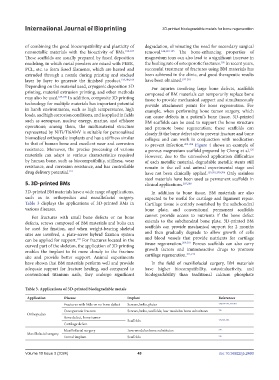
            to that of human bone and excellent wear and corrosion   to prevent infection. 202-204   Figure 4 shows an example of
            resistance.  Moreover,  the  precise  processing  of  various   a porous magnesium scaffold prepared by Cheng et al.
                                                                                                            125
            materials can adapt to various characteristics required   However, due to the unresolved application difficulties
            by human bone, such as biocompatibility, stiffness, wear   of each metallic material, degradable metallic stents still
            resistance, and corrosion resistance, and has controllable   remain in the cell and animal experimental stage and
            drug delivery potential. 191                       have not been clinically applied. 125,201,205,206  Only stainless
                                                               steel materials have been used as permanent scaffolds in
            5. 3D-printed BMs                                  clinical applications. 207,208
            3D-printed BM materials have a wide range of applications,   In addition to bone tissue, BM materials are also
            such as in orthopedics and maxillofacial surgery.   expected to be useful for cartilage and ligament repair.
            Table 3  displays the applications of 3D-printed BMs in   Cartilage tissue is entirely nourished by the subchondral
            various diseases.                                  bone  plate,  and  conventional  permanent  scaffolds
               For  fractures  with  small bone defects or  no  bone   cannot provide access to nutrients if the bone defect
            defects, screws composed of BM materials and bolts can   extends to the subchondral bone plate. 3D-printed BM
            be used for fixation, and when weight-bearing skeletal   scaffolds can provide mechanical support for 2 months
            sites are involved, a plate-screw hybrid fixation system   and then gradually degrade to allow growth of cells
                                  192
            can be applied for support.  For fractures located in the   and blood vessels that provide nutrients for cartilage
                                                                               209,210
            curved part of the skeleton, the application of 3D printing   tissue regeneration.   Porous scaffolds can also carry
            enables the implant to fit more closely to the fracture   growth factors and immunoactive drugs to promote
                                                                                 211,212
            site and provide better support. Animal experiments   cartilage regeneration.
            have shown that BM materials perform well and provide   In the field of maxillofacial surgery, BM materials
            adequate support for fracture healing, and compared to   have higher biocompatibility, osteoinductivity, and
            conventional titanium nails, they undergo significant   biodegradability than traditional calcium phosphate


            Table 3. Applications of 3D-printed biodegradable metals
             Application    Disease                    Implant                                References
                            Fractures with little or no bone defect  Screws, bolts, plates    124,193-195,197-201
                            Osteoporotic fracture      Screws, bolts, scaffolds, low-modulus bone substitutes  196
             Orthopedics
                            Bone defect, bone tumor
                                                       Scaffolds                              125,201-206
                            Cartilage defect
                            Maxillofacial surgery      Low-modulus bone substitutes           215
             Maxillofacial surgery
                            Dental implant             Scaffolds                              216


            Volume 10 Issue 3 (2024)                        49                                doi: 10.36922/ijb.2460

