


Page 58 - IJB-10-4
P. 58
International Journal of Bioprinting                                   3D bioprinting in otorhinolaryngology


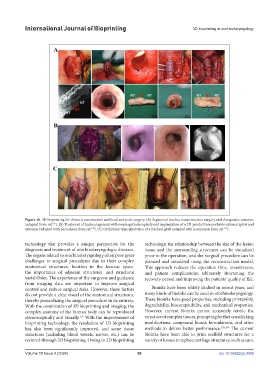
            Figure 10. 3D bioprinting for throat reconstruction and head and neck surgery. (A) Segmental trachea reconstruction surgery and therapeutic outcome
            (adapted from ref. ). (B) Treatment of tracheal agenesis with esophagotracheoplasty and implantation of a 3D-printed bioresorbable external splint and
                       195
            outcome (adapted with permission from ref. ). (C) Orthotopic transplantation of a tracheal graft (adapted with permission from ref. ).
                                        198
                                                                                                 197
            technology that provides a unique perspective for the   technology, the relationship between the size of the lesion
            diagnosis and treatment of otorhinolaryngologic diseases.   tissue and the surrounding structures can be visualized
            The organs related to otorhinolaryngology often pose great   prior to the operation, and the surgical procedure can be
            challenges  to  surgical  procedures  due  to  their  complex   planned  and simulated  using the reconstruction  model.
            anatomical structures, location in the lacunar space,   This approach reduces the operation time, invasiveness,
            the importance of adjacent structures, and structural   and  patient  complications,  ultimately  shortening  the
            variabilities. The experience of the surgeons and guidance   recovery period and improving the patients’ quality of life.
            from imaging data are important to improve surgical
            control and reduce surgical risks. However, these factors   Bioinks have been widely studied in recent years, and
            do not provide a clear visual of the anatomical structures,   many kinds of bioinks can be used in otorhinolaryngology.
            thereby jeopardizing the surgical procedure in its entirety.   These bioinks have good properties, including printability,
            With the combination of 3D bioprinting and imaging, the   degradability, biocompatibility, and mechanical properties.
            complex anatomy of the human body can be reproduced   However, current bioinks  cannot accurately mimic the
            stereoscopically and visually.  With the improvement of   structure of complex tissues, prompting further crosslinking
                                   202
            bioprinting technology, the resolution of 3D bioprinting   modifications, compound bioink formulations, and other
            has also been significantly improved, and some tissue   methods to deliver better performance. 203,204  The current
            structures (including blood vessels, nerves, etc.) can be   bioinks have been able to print scaffold structures for a
            restored through 3D bioprinting. Owing to 3D bioprinting   variety of tissues to replace cartilage structures, such as ears,

            Volume 10 Issue 4 (2024)                        50                                doi: 10.36922/ijb.3006

