


Page 117 - IJB-5-2
P. 117
Ghalayini S, et al.

                         A                                    B


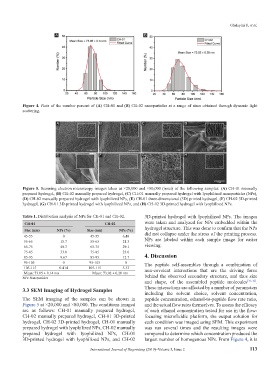
           Figure 4. Plots of the number percent of (A) CH-01 and (B) CH-02 nanoparticles at a range of sizes obtained through dynamic light
           scattering.

                         A                 B                 C                  D


                         E                 F                 G                 H


           Figure 5. Scanning electron microscopy images taken at ×20,000 and ×80,000 (inset) of the following samples: (A) CH-01 manually
           prepared hydrogel, (B) CH-02 manually prepared hydrogel, (C) CH-01 manually prepared hydrogel with lyophilized nanoparticles (NPs),
           (D) CH-02 manually prepared hydrogel with lyophilized NPs, (E) CH-01 three-dimensional (3D) printed hydrogel, (F) CH-02 3D-printed
           hydrogel, (G) CH-01 3D-printed hydrogel with lyophilized NPs, and (H) CH-02 3D-printed hydrogel with lyophilized NPs.


           Table 1. Distribution analysis of NPs for CH-01 and CH-02.  3D-printed hydrogel with lyophilized NPs. The images
           CH‑01                              CH‑02            were taken and analyzed for NPs embedded within the
           Size (nm)     NPs (%)      Size (nm)     NPs (%)    hydrogel structure. This was done to confirm that the NPs
           45-55            0          45-55         6.48      did not collapse under the stress of the printing process.
           55-65           15.7        55-65         21.3      NPs are  labeled  within  each  sample  image  for  easier
           65-75           40.3        65-75         29.1      viewing.
           75-85           33.8        75-85         23.0
           85-95           9.67        85-95         12.7      4. Discussion
           95-105           0          95-105         0        The peptide self-assembles through a combination  of
           105-115        0.414        105-115       5.33      non-covalent  interactions  that are the driving force
           Mean: 73.05 ± 0.14 nm        Mean: 73.02 ± 0.20 nm
           NPs: Nanoparticles                                  behind the observed secondary structure, and thus size
                                                               and  shape,  of  the  assembled  peptide  molecules [31-36] .
           3.3 SEM Imaging of Hydrogel Samples                 These interactions are affected by a number of parameters
                                                               including  the  solvent  choice,  solvent  concentration,
           The SEM imaging of the samples can be shown  in     peptide concentration, ethanol-to-peptide flow rate ratio,
           Figure 5 at ×20,000 and ×80,000. The conditions imaged   and the actual flow rates themselves. To assess the efficacy
           are  as  follows:  CH-01  manually  prepared  hydrogel,   of each ethanol concentration tested for use in the flow-
           CH-02 manually prepared hydrogel, CH-01 3D-printed   focusing  microfluidic  platform,  the  output  solution  for
           hydrogel, CH-02 3D-printed hydrogel, CH-01 manually   each condition was imaged using SEM. This experiment
           prepared hydrogel with lyophilized NPs, CH-02 manually   was run several times and the resulting images were
           prepared  hydrogel  with  lyophilized  NPs,  CH-01   compared to determine which concentration produced the
           3D-printed  hydrogel  with  lyophilized  NPs,  and  CH-02   largest number of homogenous NPs. From Figure 4, it is

                                       International Journal of Bioprinting (2019)–Volume 5, Issue 2       113

