


Page 280 - IJB-10-5
P. 280
International Journal of Bioprinting                                A TPMS framework for complete dentures


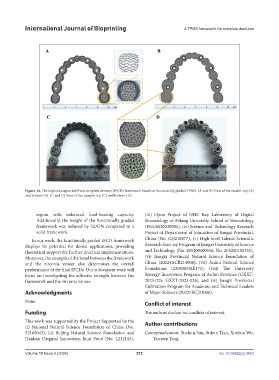
            Figure 14. The implant-supported fixed complete denture (IFCD) framework based on functionally graded TPMS. (A and B) View of the model: top (A)
            and bottom (B). (C and D) View of the sample: top (C) and bottom (D).


                 region with enhanced load-bearing capacity.   (iii) Open Project of NHC Key Laboratory of Digital
                 Additionally, the weight of the functionally graded   Stomatology of Peking University School of Stomatology
                 framework was reduced by 52.93% compared to a   (PKUSS20230501), (iv) Science and Technology Research
                 solid framework.                              Project of Department of Education of Jiangxi Provincial,
               In our work, the functionally graded IFCD framework   China (No. GJJ210877), (v) High-level Talents Scientific
            displays its potential for dental applications, providing   Research Start-up Program of Jiangxi University of Science
            theoretical support for further practical implementations.   and Technology (No. 205200100556, No. 205200100350),
            Moreover, the strength of the bond between the framework   (vi) Jiangxi Provincial Natural Science Foundation of
            and  the  zirconia  veneer  also  determines  the  overall   China (20224ACB214008), (vii) Anhui Natural Science
            performance of the final IFCDs. Our subsequent work will   Foundation  (2308085ME171),  (viii)  The  University
            focus on investigating the adhesive strength between the   Synergy Innovation Program of Anhui Province (GXXT-
            framework and the zirconia veneer.                 2023-025;  GXXT-2023-026),  and  (ix)  Jiangxi  Provincial
                                                               Cultivation Program for Academic and Technical Leaders
            Acknowledgments                                    of Major Subjects (20225BCJ23008).
            None
                                                               Conflict of interest
            Funding                                            The authors declare no conflicts of interest.
            This work was supported by the Project Supported by the   Author contributions
            (i) National Natural Science Foundation of China (No.
            52165043), (ii) Beijing Natural Science Foundation and   Conceptualization: Yuchun Sun, Sukun Tian, Xuehua Wu,
            Haidian Original Innovation Joint Fund (No. L232145),   Youwen Yang


            Volume 10 Issue 5 (2024)                       272                                doi: 10.36922/ijb.3453

