


Page 384 - IJB-10-5
P. 384
International Journal of Bioprinting                                  Tunable anisotropic gyroid bioscaffolds


            Table 3. Summary of the physical properties of the DLP-printed structures and the sintered specimens.
             Sample                        DLP-printed structures                     Sintered specimens
                            Designed porosity   Porosity after sintering  Deviation  Wall thickness  Pore diameter
                                 (%)               (%)             (%)              (µm)             (µm)
             40VF-gy             60               57.30           4.50%          274.1 ± 15.5     674.3 ± 24.9
             50VF-gy             50               46.36           7.28%          374.6 ± 15.1     576.8 ± 15.0
             60VF-gy             40               41.64           4.10%          475.7 ± 25.5     528.4 ± 28.6


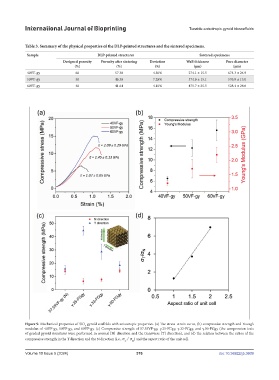
            Figure 9. Mechanical properties of SiO  gyroid scaffolds with anisotropic properties. (a) The stress–strain curve, (b) compressive strength and Young’s
                                     2
            modulus of 40VF-gy, 50VF-gy, and 60VF-gy. (c) Compressive strength of 57.55VF-gy, γ.25-FGgy, γ.33-FGgy, and γ.50-FGgy (the compression tests
            of graded gyroid structures were performed in normal [N] direction and the transverse [T] direction), and (d) the relation between the ratios of the
            compressive strength in the T direction and the N direction (i.e., σ  / σ ) and the aspect ratio of the unit cell.
                                                      T
                                                         N
            Volume 10 Issue 5 (2024)                       376                                doi: 10.36922/ijb.3609

