


Page 113 - IJB-6-4
P. 113
Matsugaki, et al.
treatments, the supernatants were disposed. The stimulation with a peak shear stress of 80 dyn/cm
2
obtained supernatants involving from the third for 4 h. Static control cells were also inserted into
to fifth treatments were collected in α-MEM. We the flow chambers without flow stimulation. The
filtrated the collections through a cell strainer (BD applied shear stress was calculated based on the
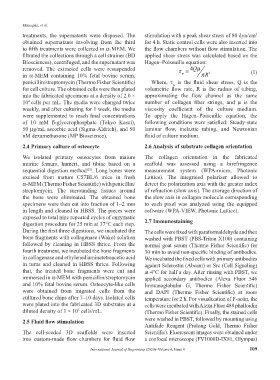
Biosciences), centrifuged, and the supernatant was Hagen–Poiseuille equation:
removed. The extracted cells were resuspended = 4Q (1)
3
in α-MEM containing 10% fetal bovine serum, w R
penicillin/streptomycin (Thermo Fisher Scientific) Where, τ is the fluid shear stress, Q is the
w
for cell culture. The obtained cells were then plated volumetric flow rate, R is the radius of tubing,
into the fabricated specimens at a density of 2.0 × approximating the flow channel as the same
10 cells per mL. The media were changed twice number of collagen fiber strings, and µ is the
4
weekly, and after culturing for 1 week, the media viscosity coefficient of the culture medium.
were supplemented to reach final concentrations To apply the Hagen–Poiseuille equation, the
of 10 mM β-glycerophosphate (Tokyo Kasei), following conditions were satisfied: Steady-state
50 µg/mL ascorbic acid (Sigma-Aldrich), and 50 laminar flow, inelastic tubing, and Newtonian
nM dexamethasone (MP Bioscience). fluid of culture medium.
2.4 Primary culture of osteocyte 2.6 Analysis of substrate collagen orientation
We isolated primary osteocytes from mature The collagen orientation in the fabricated
murine femurs, humeri, and tibiae based on a scaffold was assessed using a birefringence
sequential digestion method . Long bones were measurement system (WPA-micro, Photonic
[21]
excised from mature C57BL/6 mice in fresh Lattice). The integrated polarizer allowed to
α-MEM (Thermo Fisher Scientific) with penicillin/ detect the polarization axis with the greater index
streptomycin. The surrounding tissues around of refraction (slow axis). The average direction of
the bone were eliminated. The obtained bone the slow axis in collagen molecule corresponding
specimens were then cut into fraction of 1–2 mm to each pixel was analyzed using the equipped
in length and cleaned in HBSS. The pieces were software (WPA-VIEW, Photonic Lattice).
exposed to total nine repeated cycles of enzymatic
digestion procedure for 25 min at 37°C each step. 2.7 Immunostaining
During the first three digestions, we incubated the The cells were fixed with paraformaldehyde and then
bone fragments with collagenase (Wako) solution washed with PBST (PBS-Triton X100) containing
followed by cleaning in HBSS thrice. From the normal goat serum (Thermo Fisher Scientific) for
fourth treatment, we incubated the bone fragments 30 min to avoid non-specific binding of antibodies.
in collagenase and ethylenediaminetetraacetic acid We incubated the fixed cells with primary antibodies
in turns and cleaned in HBSS thrice. Following against Sclerostin (Abcam) or Src (Cell Signaling)
that, the treated bone fragments were cut and at 4°C for half a day. After rinsing with PBST, we
immersed in α-MEM with penicillin/streptomycin applied secondary antibodies (Alexa Fluor 546
and 10% fetal bovine serum. Osteocyte-like cells Immunoglobulin G, Thermo Fisher Scientific)
were obtained from migrated cells from the and DAPI (Thermo Fisher Scientific) at room
cultured bone chips after 7–10 days. Isolated cells temperature for 2 h. For visualization of F-actin, the
were plated into the fabricated 3D substrates at a cells were incubated with Alexa Fluor 488 phalloidin
diluted density of 1 × 10 cells/mL. (Thermo Fisher Scientific). Finally, the stained cells
5
2.5 Fluid flow stimulation were washed in PBST, followed by mounting using
Antifade Reagent (Prolong Gold, Thermo Fisher
The cell-seeded 3D scaffolds were inserted Scientific). Fluorescent images were obtained under
into custom-made flow chambers for fluid flow a confocal microscope (FV1000D-IX81, Olympus)
International Journal of Bioprinting (2020)–Volume 6, Issue 4 109

