


Page 19 - IJB-6-4
P. 19
Shpichka, et al.

                                                                                                              (Contd...)
                Ref.    [8]    [62]      [49]  [45]  [46]  [39]          [71]   [55]    [72]   [73]      [74]


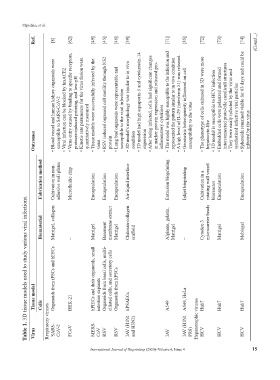
                          susceptible to SARS-CoV-2 Blood vessel and human kidney organoids were  • Viral infection can be blocked by hrsACE2 Virus entry caused by binding to specific receptors,  protease-induced priming, and low-pH Kinetic rate parameters for the virus fusion were   quantitatively measured Tissue models were successfully infected by the  RSV induced organoid cell motility through NS2  Lung bud organoids were representable and  susceptible to the viral in


                Outcomes  •    •    •    •    virus  •    protein  •    •    condition  •    expression  •    •    •    •    hepatocyte-like  •    •    •


                   Fabrication method  Cultivation in non-  adhesive well plates   Microfluidic chip  Encapsulation  Encapsulation  Encapsulation  Air-liquid interface  Extrusion bioprinting  Inkjet bioprinting  Cultivation in a   rotating wall vessel   bioreactor  Encapsulation  Encapsulation


            Table 1. 3D tissue models used to study various viral infections.


                   Biomaterial  Matrigel, collagen   –  Matrigel  Basement   membrane extract   Matrigel  Chitosan-collagen   scaffold  Alginate, gelatin,   Matrigel  –  Cytodex-3   microcarrier beads  Matrigel  Mebiogel


                        Organoids from iPSCs and hESCs  hPIECs and their organoids, small   Organoids from basal cells, multi- ciliated cells, and secretory cells


                Tissue model  Cells  BHK-21  intestine explants  Organoids from hPSCs  hPSAECs  A549   A549, HeLa   Huh7  Huh7  Huh7


                Virus  Respiratory viruses  SARS-  CoV-2  FCoV  MERS-  CoV  RSV  RSV  IAV (H1N1   and H3N2)  IAV  IAV (H1N1   PR8)  Hepatotrophic viruses  HCV  HCV  HCV


                                       International Journal of Bioprinting (2020)–Volume 6, Issue 4        15

