


Page 18 - IJB-6-4
P. 18
Bioprinting, microfluidics, and organoids to defeat COVID-19
           industrial  production of diagnostic reagents,      they are native tissues with relevant morphology.
           vaccines, etc., due to a simple scaling procedure    However, their application is significantly limited
                                                        [40]
           V.  However,  it  was  significantly  improved  by   because of low availability and shortage of donor
           adding  microcarriers  –  small  particles  of  a  cell   materials, short viability, and rapid necrosis .
                                                                                                        [50]
           adhesive substrate (e.g., Cytodex 3). Such method     Scaffold-  and  hydrogel-based  models  can
           modification  was  approved  for  the  production   provide  a  3D  microenvironment  that  mimics
           of  a  RSV  vaccine   and  research  on  virus-host   conditions in vivo  for  cells.  Biomaterials  that
                             [43]
           interactions .                                      ensure  necessary  cell-matrix  interactions  and
                      [44]
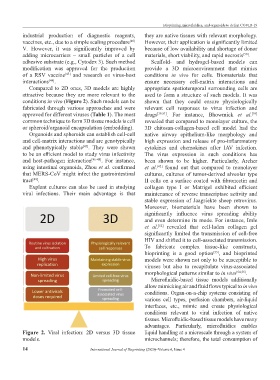
             Compared to 2D ones, 3D models are highly         appropriate spatiotemporal surrounding cells are
           attractive  because  they  are  more  relevant  to  the   used to form a structure of such models. It was
           conditions in vivo (Figure 2). Such models can be   shown  that  they  could  ensure  physiologically
           fabricated  through  various  approaches  and  were   relevant  cell  responses to virus infection  and
           approved for different viruses (Table 1). The most   drugs [39,51] .  For  instance,  Bhowmick  et al.
                                                                                                            [39]
           common technique to form 3D tissue models is cell   revealed that compared to monolayer culture, the
           or spheroid/organoid encapsulation (embedding).     3D  chitosan-collagen-based  cell  model  had  the
             Organoids and spheroids can establish cell-cell   native  airway  epithelium-like  morphology  and
           and cell-matrix interactions and are genotypically   high expression and release of pro-inflammatory
           and  phenotypically  stable .  They  were  shown    cytokines  and  chemokines  after  IAV  infection.
                                    [45]
           to be an efficient model to study virus infectivity   The  virus  expression  in  such  conditions  has
           and  host-pathogen  interaction [46-48] .  For  instance,   been  shown  to  be  higher.  Particularly,  Archer
           using intestinal organoids, Zhou et al. confirmed   et  al.   found  out  that  compared  to  monolayer
                                                                    [42]
           that MERS-CoV might infect the gastrointestinal     cultures, cultures of tumor-derived alveolar type
           tract .                                             II cells on a surface coated with fibronectin and
               [49]
             Explant cultures can also be used in studying     collagen  type  I  or  Matrigel  exhibited  efficient
           viral  infections.  Their  main  advantage  is  that   maintenance of reverse transcriptase activity and
                                                               stable  expression  of  Jaagsiekte sheep  retrovirus.
                                                               Moreover,  biomaterials  have  been  shown  to
                                                               significantly  influence  virus  spreading  ability
                                                               and even determine its mode. For instance, Imle
                                                               et al.   revealed  that  cell-laden  collagen  gel
                                                                    [52]
                                                               significantly limited the transmission of cell-free
                                                               HIV and shifted it to cell-associated transmission.
                                                               To  fabricate  complex  tissue-like  constructs,
                                                               bioprinting  is a  good  option ,  and  bioprinted
                                                                                            [53]
                                                               models were shown not only to be susceptible to
                                                               viruses  but  also  to  recapitulate  virus-associated
                                                               morphological patterns similar to in vivo [54,55] .
                                                                 Microfluidic-based  tissue  models  additionally
                                                               allow mimicking air and fluid flows typical to in vivo
                                                               conditions. Organ-on-a-chip systems consisting of
                                                               various  cell  types,  perfusion  chambers,  air-liquid
                                                               interfaces,  etc.,  mimic  and  create  physiological
                                                               conditions relevant to viral infection of native
                                                               tissues. Microfluidic-based tissue models have many
                                                               advantages.  Particularly,  microfluidics  enables
           Figure  2.  Viral infection: 2D versus 3D tissue    liquid handling at a microscale through a system of
           models.                                             microchannels; therefore, the total consumption of

           14                          International Journal of Bioprinting (2020)–Volume 6, Issue 4

