


Page 57 - IJB-6-4
P. 57
Bishop and Leigh
           for the thermoplastic component was 3DFilaPrint
           Premium  polylactic  acid  (PLA)  2.85  mm
           (3DFilaPrint,  UK).  All  print  parameters  were
           previously  determined  empirically  through an
           iterative process. The key print parameters used
           were: 1.8 mm extrusion width; 1 mm layer height;
           0%  infill;  230°C  extrusion  temperature;  and
           50 mm/s default printing speed.

           3 Results and discussion

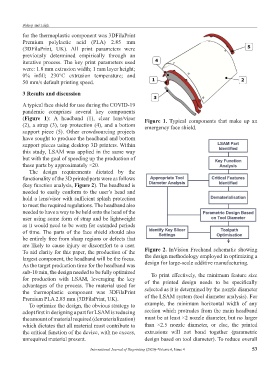
           A typical face shield for use during the COVID-19
           pandemic comprises several key components
           (Figure  1):  A  headband  (1),  clear  lens/visor   Figure  1.  Typical  components that  make  up an
           (2), a strap (3), top protection (4), and a bottom   emergency face shield.
           support  piece  (5).  Other  crowdsourcing  projects
           have sought to produce the headband and bottom
           support pieces using desktop 3D printers. Within
           this study, LSAM was applied in the same way
           but with the goal of speeding up the production of
           these parts by approximately ×20.
             The design requirements dictated by the
           functionality of the 3D printed parts were as follows
           (key function analysis, Figure 2). The headband is
           needed to easily conform to the  user’s head and
           hold a lens/visor with sufficient splash protection
           to meet the required regulations. The headband also
           needed to have a way to be held onto the head of the
           user using some form of strap and be lightweight
           as it would need to be worn for extended periods
           of  time. The  parts  of  the  face  shield  should  also
           be entirely free from sharp regions or defects that
           are likely to cause injury or discomfort to a user.
           To aid clarity for this paper, the production of the   Figure 2. InVision Freehand schematic showing
           largest component, the headband will be the focus.   the design methodology employed in optimizing a
           As the target production time for the headband was   design for large-scale additive manufacturing.
           sub-10 min, the design needed to be fully optimized   To print effectively, the minimum feature size
           for  production  with  LSAM,  leveraging  the  key   of  the  printed  design  needs  to  be  specifically
           advantages  of  the  process. The  material  used  for
           the  thermoplastic  component  was  3DFilaPrint     selected as it is determined by the nozzle diameter
           Premium PLA 2.85 mm (3DFilaPrint, UK).              of the LSAM system (tool diameter analysis). For
             To optimize the design, the obvious strategy to   example,  the  minimum  horizontal  width  of  any
           adopt first in designing a part for LSAM is reducing   section which protrudes from the main headband
           the amount of material required (dematerialization)   must be at least ×2 nozzle diameter, but no larger
           which dictates that all material must contribute to   than  ×2.5  nozzle  diameter,  or  else,  the  printed
           the critical function of the device, with no excess,   extrusions  will  not  bond  together  (parametric
           unrequired material present.                        design based on tool diameter). To reduce overall

                                       International Journal of Bioprinting (2020)–Volume 6, Issue 4        53

