


Page 58 - IJB-6-4
P. 58
Large-Scale AM for Manufacturing PPE during COVID-19
           travel  moves  made  by  the  printer,  the  largest   digital design work was carried out in Autodesk
           possible  nozzle  should  be  chosen,  but  to  ensure   Fusion  360. A  key  focus  for  the  design  was  to
           that the parts stay lightweight with sensible feature   ensure  the  final  shield  would  pass  any  relevant
           sizes,  a  balance  must  be  struck.  In  this  case,  a   regulatory testing, which determined aspects such
           1.8 mm nozzle was selected to achieve this required   as the height of the headband being no <10 mm tall.
           balance. The 1.8 mm nozzle allowed for deposition   The second key design aspect was the attachment
           rates of 92 mm /s, (printing a headband with <20 g   points  for  the  clear  lens/visor.  The  visor  holes
                         3
           of PLA) while allowing for the features to be small   would be made using a standard 6 mm diameter
           enough for functions such as the attachment of the   hole punch, and therefore, the attachment points
           lens/visor. The headbands were designed with no     were designed with a 5.5 mm width, distributed
           overhanging sections to ensure that no material or   around the front loop of the headband. Ensuring
           time wasted in printing support material. The final   that the printed parts were not sharp and likely to
           strategy to adopt is to ensure that every move of   injure the user might normally require filleting of
           the print nozzle in the print job is a useful move,   edges in the design, but fillets were not required
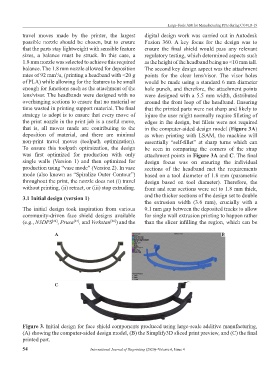
           that is, all moves made are contributing to the     in the computer-aided design model (Figure 3A)
           deposition of material, and there are minimal       as  when  printing  with  LSAM, the  machine  will
           non-print  travel  moves  (toolpath  optimization).   essentially  “self-fillet”  at  sharp  turns  which  can
           To  ensure  this  toolpath  optimization,  the  design   be  seen in  comparing  the corners of the  strap
           was  first  optimized  for  production  with  only   attachment points in Figure 3A and C. The final
           single  walls  (Version  1)  and  then  optimized  for   design  focus  was on  ensuring  the  individual
           production using “vase mode” (Version 2). In vase   sections of the headband met the requirements
           mode (also known as “Spiralize Outer Contour”)      based on a tool diameter of 1.8 mm (parametric
           throughout the print, the nozzle does not (i) travel   design  based  on  tool  diameter).  Therefore,  the
           without printing, (ii) retract, or (iii) stop extruding.  front and rear sections were set to 1.8 mm thick,

           3.1 Initial design (version 1)                      and the thicker sections of the design set to double
                                                               the  extrusion  width  (3.6  mm),  crucially  with  a
           The initial  design took inspiration  from various   0.1 mm gap between the deposited tracks to allow
           community-driven  face  shield  designs available   for single wall extrusion printing to happen rather
           (e.g., N3DPS , Prusa , and Verkstan ) and the       than the slicer infilling the region, which can be
                       [24]
                                                [26]
                                [25]
                        A                                                                      B


                        C


           Figure 3. Initial design for face shield components produced using large-scale additive manufacturing,
           (A) showing the computer-aided design model, (B) the Simplify3D sliced print preview, and (C) the final
           printed part.

           54                          International Journal of Bioprinting (2020)–Volume 6, Issue 4

