


Page 135 - IJB-10-6
P. 135
International Journal of Bioprinting Fluid mechanics of extrusion bioprinting
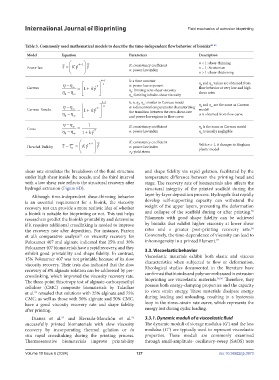
Table 3. Commonly used mathematical models to describe the time-independent flow behavior of bioinks 80–85
Model Equation Parameters Description
n −1 n < 1: shear-thinning
Power-law τ = Kγγ i γ i K: consistency coefficient n = 1: Newtonian
n: power-law index
n > 1: shear-thickening
n −1 k: a time constant
−
ηη 2 2 n: power-law exponent η and η values are obtained from
0
∞
Carreau ∞ = 1 + kγγ i flow behavior at very low and high
η − η ∞ η : limiting zero-shear viscosity shear rates
0
0
η : limiting infinite-shear viscosity
∞
n −1 k, n, η , η : similar to Carreau model
∞
0
ηη α α α: a dimensionless parameter characterizing η and η are the same as Carreau
−
∞
0
Carreau-Yasuda ∞ = 1 + kγγ i model
η − η ∞ the transition between the zero-shear-rate α is obtained from flow curve
and power-law regions in flow curve
0
−
ηη 1
Cross ∞ = n K: consistency coefficient η is the same as Carreau model
0
η − η ∞ 1 + kγγ i n: power-law index η is usually negligible
∞
0
n −1 K: consistency coefficient
Herschel-Bulkley τ − τ = Kγγ i γ i n: power-law index With n = 1, it changes to Bingham
0
τ : yield stress plastic model
0
shear rate simulates the breakdown of the fluid structure and shape fidelity via rapid gelation, facilitated by the
under high shear inside the nozzle, and the third interval temperature difference between the printing head and
with a low shear rate reflects the structural recovery after stage. The recovery rate of biomaterials also affects the
hydrogel extrusion (Figure 6D). structural integrity of the printed scaffold during the
Although time-independent shear-thinning behavior layer-by-layer deposition process. Hydrogels that rapidly
is an essential requirement for a bioink, the viscosity develop self-supporting capacity can withstand the
recovery test can provide a more realistic idea of whether weight of the upper layers, preventing the deformation
50
a bioink is suitable for bioprinting or not. This test helps and collapse of the scaffold during or after printing.
researchers predict the bioink’s printability and determine Filaments with good shape fidelity can be achieved
if it requires additional crosslinking is needed to improve by bioinks that exhibit higher viscosity at lower shear
96
the recovery rate after deposition. For instance, Paxton rates and a greater post-printing recovery rate.
92
et al.’s comparative analysis on viscosity recovery for Conversely, the time-dependence of viscosity can lead to
Poloxamer 407 and alginate indicated that 25% and 30% inhomogeneity in a printed filament. 97
Poloxamer 407 biomaterials have a rapid recovery, and they 3.3. Viscoelastic behavior
exhibit good printability and shape fidelity. In contrast, Viscoelastic materials exhibit both elastic and viscous
15% Poloxamer 407 was not printable because of its slow characteristics when subjected to flow or deformation.
viscosity recovery. Their tests also indicated that the slow Rheological studies documented in the literature have
recovery of 8% alginate solution can be addressed by pre-
crosslinking, which improved the viscosity recovery rate. confirmed that bioinks and polymer melts used in extrusion
36,98
The three-point thixotropy test of alginate-carboxymethyl bioprinting are viscoelastic materials. Therefore, they
cellulose (CMC) composite biomaterials by Tuladhar possess both energy-damping properties and the capacity
et al. revealed that solutions with 25% alginate and 75% to store strain energy. These materials dissipate energy
93
CMC, as well as those with 50% alginate and 50% CMC, during loading and unloading, resulting in a hysteresis
have a good viscosity recovery rate and shape fidelity loop in the stress–strain rate curve, which represents the
after printing. energy lost during cyclic loading.
Diañez et al. and Herrada-Manchón et al. 95 3.3.1. Dynamic moduli of a viscoelastic fluid
94
successfully printed biomaterials with slow viscosity The dynamic moduli of storage modulus (Gʹ) and the loss
recovery by incorporating thermal gelation or in modulus (G˝) are typically used to represent viscoelastic
situ rapid crosslinking during the printing process. properties. These moduli are commonly examined
Thermosensitive biomaterials improve printability through small-amplitude- oscillatory-sweep (SAOS) tests
Volume 10 Issue 6 (2024) 127 doi: 10.36922/ijb.3973

