


Page 120 - IJB-8-2
P. 120
Microstructured Calcium Phosphate Ceramics Scaffolds by Material Extrusion
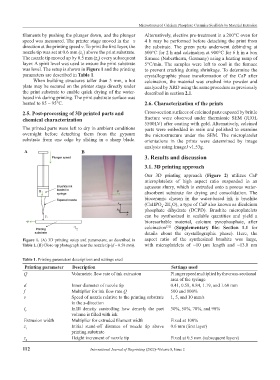
           filaments by pushing the plunger down, and the plunger   Alternatively, elective pre-treatment in a 200°C oven for
           speed was measured. The printer stage moved in the –x   4 h may be performed before detaching the print from
           direction at the printing speed v. To print the first layer, the   the  substrate.  The  green  parts  underwent  debinding  at
           nozzle tip was set at 0.6 mm (z ) above the print substrate.   500°C for 2 h and calcination at 900°C for 6 h in a box
                                    1
           The nozzle tip moved up by 0.5 mm (z ) every subsequent   furnace (Nabertherm, Germany) using a heating ramp of
                                          2
           layer. A spirit level was used to ensure the print substrate   5°C/min. The  samples  were  left  to  cool  in  the  furnace
           was level. The setup is shown in Figure 1 and the printing   to prevent cracking during shrinkage. To determine the
           parameters are described in Table 1.                crystallographic  phase transformation  of the  CaP after
               When  building  structures  taller  than  3  mm,  a  hot   calcination,  the  material  was  crushed  into  powder  and
           plate may be secured on the printer stage directly under   analyzed by XRD using the same procedure as previously
           the print substrate to enable quick drying of the water-  described in section 2.1.
           based ink during printing. The print substrate surface was
           heated to 85 – 95°C.                                2.6. Characterization of the prints

           2.5. Post-processing of 3D printed parts and        Cross-section surfaces of calcined parts exposed by brittle
           chemical characterization                           fracture  were  observed  under  thermionic  SEM  (JEOL
                                                               5500LV) after coating with gold. Alternatively, calcined
           The printed parts were left to dry in ambient conditions   parts were embedded in resin and polished to examine
           overnight  before  detaching  them  from  the  gypsum   the  microstructure  under  the  SEM.  The  microplatelet
           substrate  from  one  edge  by  sliding  in  a  sharp  blade.   orientations  in  the  prints  were  determined  by  image
                                                               analysis using ImageJ v1.53g.
           A                        B
                                                               3. Results and discussion
                                                               3.1. 3D printing approach

                                                               Our  3D  printing  approach  (Figure  2)  utilizes  CaP
                                                               microplatelets  of high aspect  ratio  suspended in an
                                                               aqueous slurry, which is extruded onto a porous water-
                                                               absorbent  substrate  for  drying  and  consolidation.  The
                                                               bioceramic  chosen  in  the  water-based  ink  is  brushite
                                                               (CaHPO ·2H O), a type of CaP also known as dicalcium
                                                                          2
                                                                      4
                                                               phosphate  dihydrate  (DCPD).  Brushite  microplatelets
                                                               can  be  synthesized  in  scalable  quantities  and  yield  a
                                                               bioresorbable  material,  calcium  pyrophosphate,  after
                                                               calcination  (Supplementary  file:  Section  1.1 for
                                                                        [32]
                                                               details  about  the  crystallographic  phase).  Here,  the
           Figure 1. (A) 3D printing setup and parameters, as described in   aspect  ratio  of  the  synthesized  brushite  was  large,
           Table 1. (B) Close-up photograph near the nozzle tip (d = 0.58 mm).  with  microplatelets  of  ~10  µm  length  and  ~13.8  nm


           Table 1. Printing parameters descriptions and settings used
           Printing parameter   Description                               Settings used
           Q                   Volumetric flow rate of ink extrusion      Plunger speed multiplied by the cross-sectional
                                                                          area of the syringe
           d                   Inner diameter of nozzle tip               0.41, 0.58, 0.84, 1.19, and 1.60 mm
           f                   Multiplier for ink flow rate Q             500 and 800%
           v                   Speed of nozzle relative to the printing substrate   1, 5, and 10 mm/s
                               in the x-direction
           I                   Infill  density  controlling  how  densely  the  part   30%, 50%, 70%, and 90%
            f
                               volume is filled with ink
           Extrusion width     Multiplier for extruded filament width     Fixed at 100%
           z                   Initial  stand-off  distance  of  nozzle  tip  above   0.6 mm (first layer)
            1
                               printing substrate
           z                   Height increment of nozzle tip             Fixed at 0.5 mm (subsequent layers)
            2
           112                         International Journal of Bioprinting (2022)–Volume 8, Issue 2

